
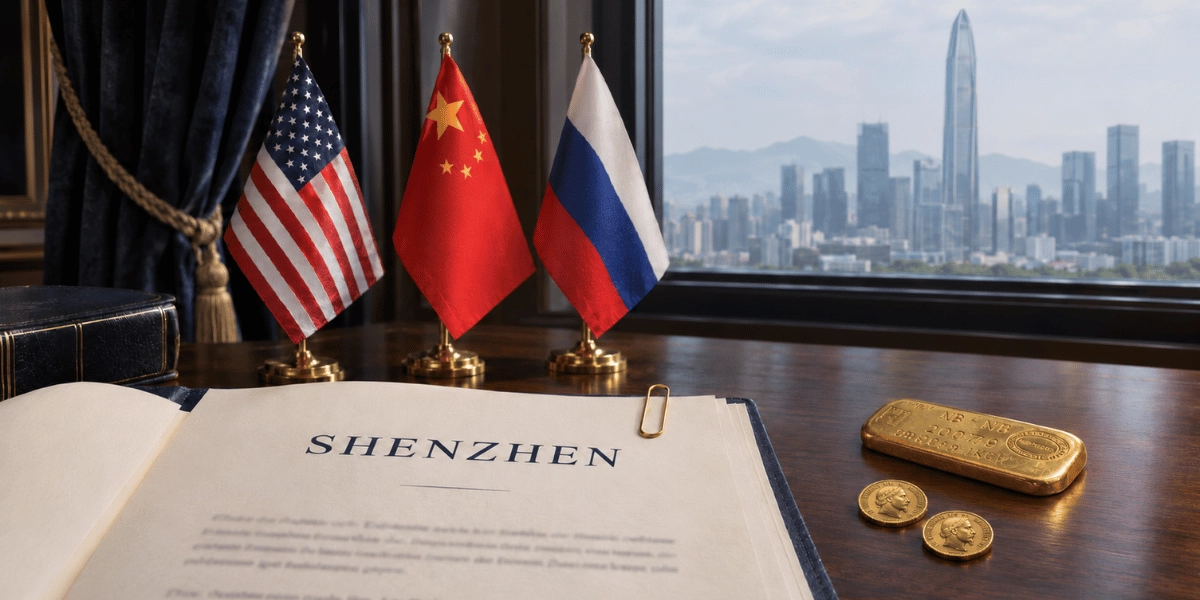
Gold prices may fall even as geopolitical risks persist. This is the assessment in the wake of the Shenzhen summit, which brought together Donald Trump, Xi Jinping, and Vladimir Putin on November 19. The leaders opened a dialogue without announcing any resolution to conflicts or specific reductions in arsenals. Yet, on Friday, November 20, the metal continued its decline.
This contrast does not mean that gold has lost its role as a safe haven. It serves as a reminder that its price is driven by multiple forces: purchases motivated by uncertainty can be offset by sales linked to monetary expectations, the appreciation of the dollar, or portfolio adjustments.
Following the Trump-Xi-Putin summit, why is gold falling despite geopolitical uncertainties? To understand this trend, we must distinguish between what the meeting actually changed, potential factors supporting demand, and the factors currently driving the market. For a French investor, this analysis must also take into account exchange rates and the prices of physical gold.
Key Takeaways from the Article
- The November 19 summit in Shenzhen resulted in a joint statement and the continuation of dialogue, but no concrete agreement on arms reduction or announced resolution of conflicts.
- Uncertainty may fuel demand for safe-haven assets, but not enough to prevent a decline in the price of gold.
- A strong dollar and expectations of rising U.S. interest rates are weighing on the metal. The lack of a diplomatic agreement is not enough to reverse these pressures.
- On November 20 at 6:04 a.m. Paris time, gold was trading at $3,525.25 per ounce, down 2.7%. Demand for a safe haven is therefore not enough to support its price.
- For a French investor, it is important to track the price in euros and distinguish between the geopolitical premium and the commercial premium on coins and bullion.
Shenzhen: A Joint Statement, but No Operational Breakthrough
Meeting on Thursday, November 19, in Shenzhen on the sidelines of the APEC summit, Donald Trump, Xi Jinping, and Vladimir Putin discussed international stability and nuclear risks. The official Chinese account outlines the positions expressed by each leader: Xi Jinping called for maintaining channels of communication and preventing crises; Vladimir Putin advocated for cooperation based on mutual respect and energy security; Donald Trump emphasized the responsibility of the three nuclear powers in preventing proliferation. Following the discussion, the leaders adopted a joint statement calling for dialogue on reducing nuclear risks, reforming the UN, and increasing the supply of refined petroleum products. The document also addresses the immunities of public officials and the jurisdiction of international courts. However, it contains neither specific commitments to reduce arsenals nor agreements on Ukraine or Iran—two conflicts absent from the final text.
The assessment available as of November 20 confirms the limitations of this declaration: no timeline for negotiations on an arsenal reduction treaty has been announced. Chinese Foreign Minister Wang Yi referred to coordination at the technical level. The dialogue continues, but its translation into verifiable measures remains to be seen.
For investors, the difference lies between a political intention and a verifiable change in risk.
The demand for protection does not dictate the direction of the price
The geopolitical premium refers to the support that international uncertainty can provide to the price of gold. It does not correspond to a separately listed premium in the price quote. Its amount cannot be isolated from a single trading session, since multiple factors are at play simultaneously.
When risks of conflict, sanctions, or trade disruptions persist, some investors may maintain their hedging positions. But holding onto gold does not mean buying more of it: this demand may persist without offsetting sales by other holders. A decline in the price, therefore, does not in itself indicate that all safe-haven demand has disappeared.
The World Gold Council highlights the combined influence of geopolitics, monetary conditions, and investor behavior. Gold therefore remains a diversification tool, but its status as a safe-haven asset guarantees neither an immediate rise nor a price floor.
The lack of an agreement does not necessarily constitute a new shock
A summit without a breakthrough does not necessarily surprise the markets. If investors were primarily expecting an initial engagement, the outcome does little to alter their perception of risk. The persistence of tensions, therefore, does not in itself provide a new reason to buy gold.
Conversely, disappointment regarding expectations of de-escalation could encourage some protective buying. Without measuring these flows, however, it would be an overstatement to claim that the summit created an additional premium or triggered the observed decline.
Dialogue remains valuable: communication channels can help limit misjudgments. To transform this opening into lasting détente, what is now needed are deadlines, verification mechanisms, and commitments backed by concrete action. The market will evaluate these advances rather than simply the fact that the meeting took place.
The dollar and the Fed are exerting greater pressure in the short term
Data from November 20 illustrates the extent of the selling pressure. At 5:04 a.m. GMT, or 6:04 a.m. in Paris, spot gold was trading at $3,525.25 per ounce, down 2.7%. It was down about 9.2% since the start of the week, heading toward its steepest weekly decline since March. This intraday figure does not represent a closing price.
The dollar was trading near its highest level in nineteen months, while the vast majority of markets anticipated a 25-basis-point rate hike by the Fed in December. These expectations may weigh on gold even before an actual monetary policy decision is made. They remain subject to revision as new data is released.
The minutes from the Fed’s October 27–28 meeting, released on November 18, provide a recent insight: nearly all participants believed that further rate hikes were likely appropriate under their central economic scenario. These minutes describe the October discussions; they do not, on their own, prejudge the December decision.
The Chicago Fed highlights gold’s sensitivity to real interest rates—that is, yields adjusted for expected inflation. When real interest rates rise, holding a non-interest-bearing asset becomes relatively more expensive. A stronger dollar can also curb purchases by investors using other currencies. These mechanisms may outweigh demand for safe-haven assets.
Energy remains a two-way factor
As of November 20, the joint statement remains a general commitment regarding the supply of refined petroleum products: it specifies neither the expected additional volumes nor their delivery schedule. We will need to monitor announcements regarding implementation and the security of supply flows. The EIA notes that actual or potential supply disruptions can influence oil prices.
While energy risks remain high, they may fuel the search for safe-haven assets. However, high energy prices can also prolong inflationary pressures and reinforce expectations of high interest rates, to the detriment of gold.
Conversely, an improvement in supply could mitigate geopolitical risk while reducing monetary pressure. The ultimate direction of the market reaction would depend largely on real interest rates, not on oil alone.
For French investors: Distinguishing Between Exchange Rates and Physical Premiums
The price of gold in euros also depends on the EUR/USD exchange rate. A dollar that appreciates against the euro can cushion a decline in the price per ounce in dollars, without necessarily eliminating it. Gold and exchange rate quotes must be taken at the same moment to measure this effect; the data cited here do not allow for quantifying a synchronized performance in euros.
The geopolitical premium must also be distinguished from the commercial premium of a coin or bar—that is, the difference between its price and its metal value. The latter depends in particular on the format, supply, and demand. Before a transaction, the total price and buyback terms must be compared.
Conclusion
Gold remains a potential diversification tool in an uncertain world, but this role does not mean it must rise after every peak. Shenzhen issued a statement of intent, not a Gold is falling after Shenzhen because the lack of diplomatic détente is not enough to offset monetary pressures and the strength of the dollar. Uncertainties may sustain demand for a safe-haven asset, without guaranteeing a rise or a price floor. As of November 20, the most sound interpretation is therefore to distinguish gold’s role as a wealth preservative from its immediate performance. For French investors, the price in euros and the terms for buying or reselling physical gold products round out this analysis.
By La rédaction Godot & Fils
Passionate and expert in the field of buying and selling precious metals, we put our expertise at your service to offer you in-depth analyses of gold and silver financial news. Driven by the desire to provide you with clear, reliable and relevant information, we ensure that each piece of content is both precise and concise. Our aim is to help you better understand market trends so that you can make informed decisions about your investments. Through our articles, we offer practical advice, decoding of major economic events and technical analysis to maximise your investment opportunities. Whether you are a beginner or an experienced investor, our content is designed to help you succeed in your precious metals investments. Follow us so that you don't miss out on any market developments and benefit from an expert's view of gold, silver and the economic dynamics that shape their value.
Receive the latest news by subscribing to the newsletter

 10 Francs Turin 1929 - 1939

 Zodiac Series : Pisces 1 Oz Silver


 20 Francs Tunisia


