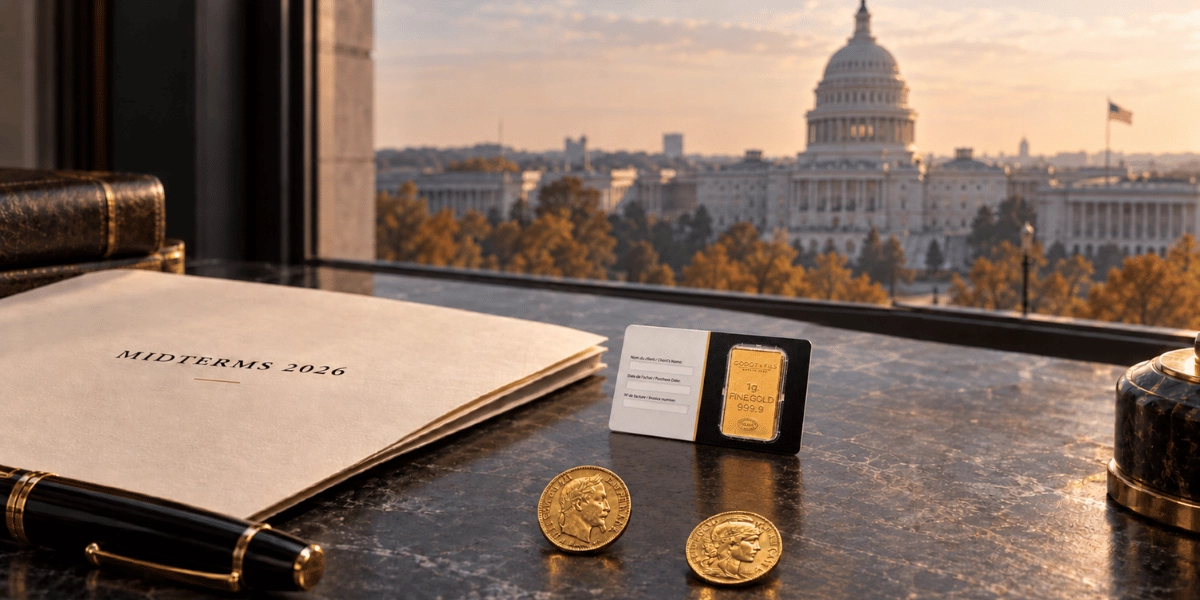
The U.S. midterm elections on Tuesday, November 3, 2026, mark the start of a sensitive week for the markets. Voters will elect a new House of Representatives and a portion of the Senate, but will not elect a new president. The outcome will determine the balance of power in the U.S. Congress and the Trump administration’s ability to push through its agenda.
For gold, however, the stakes go beyond which party wins. Investors will primarily seek to understand how the new political landscape will affect government spending, debt, inflation, and interest rates. These expectations can quickly be reflected in prices, even before any legislation is passed.
Could the outcome of the 2026 midterms therefore boost the price of gold as early as this week, particularly for a French investor? A reaction is possible, but its direction remains uncertain. To assess this, we must distinguish between an electoral surprise, the policies that will follow, and the dollar’s movement against the euro. As of November 2, no results are known yet: considering various scenarios helps avoid jumping to conclusions.
Key Takeaways from the Article
- The U.S. elections on November 3, 2026, could trigger rapid price movements in gold. As of November 2, the outcome remains unknown: the scenarios presented are hypotheses, with no probabilities assigned.
- Control of Congress influences the outlook for spending, taxes, and debt. These expectations can affect U.S. interest rates and the dollar, with effects on gold that are sometimes contradictory.
- For a French investor, the price of gold in euros also depends on the exchange rate. A rise in the price of gold in dollars may be offset by an appreciation of the euro.
- The election result alone is not a sufficient buy signal. The policies actually adopted, the Federal Reserve’s response, and economic data will be the determining factors over the long term.
Why the Election Could Cause Gold to Move Rapidly
A market reacts primarily to the gap between expectations and the actual outcome. A widely anticipated majority may elicit only a limited reaction. An unexpected shift or a particularly narrow majority, on the other hand, can trigger rapid adjustments.
Uncertainty also plays a role. If several races remain too close to call, the composition of Congress may take time to become clear. The search for safe-haven assets could then support gold, but also the dollar. These two movements are not mutually exclusive during periods of tension.
This initial move does not prejudge the trend. Political calm may reduce demand for safe-haven assets, while a reassessment of interest rate prospects may become the dominant factor in subsequent trading sessions.
Three Possible Scenarios for Congress, No Automatic Outcome
The scenarios below describe possible mechanisms, not forecasts. The size of the majorities, compromises among elected officials, and the content of the legislation will be decisive.
| Outcome | Dollars and rates: possible mechanism | Implications for gold |
| Two Republican-controlled chambers | If new measures widen deficits: potential pressure on rates and support for the dollar. | Higher real interest rates could weigh on the market; debt concerns could support demand for safe-haven assets. |
| Divided Congress | Compromises will be more difficult; the impact on rates and the dollar will depend on budget agreements. | No predetermined course: balancing the need to calm market expectations against the risk of gridlock. |
| Both chambers controlled by Democrats | The executive branch’s agenda is more constrained; outcomes depend on negotiations with the presidency. | A decline in real interest rates could help gold; a weaker dollar could limit gains in euros. |
A divided Congress could consist of a Democratic House and a Republican Senate, or vice versa. In either case, compromise becomes essential. A stalemate could slow new spending but also complicate the agreements needed to fund the government.
Even if the Democrats win both chambers, they do not control the presidency. Legislation remains subject to the legislative process and the presidential veto. Conversely, a Republican majority does not guarantee the full adoption of the executive branch’s agenda.
The Dollar and Gold: The Decisive Role of Real Interest Rates
A policy that increases public financing needs can put pressure on bond yields. But it is important to distinguish between nominal rates and real rates, which take expected inflation into account.
When real yields rise, holding a non-interest-bearing asset such as gold can become less attractive. The World Gold Council identifies this opportunity cost as one of the drivers of gold prices. Conversely, a decline in real yields can provide support for gold, all else being equal.
Fiscal expansion is therefore not automatically favorable for gold. It can fuel a search for protection against inflation, while simultaneously strengthening interest rates and the dollar. The relative strength of these forces will determine the market’s reaction.
The monetary policy environment remains key: on October 28, 2026, the Federal Reserve kept its benchmark rate between 3.75% and 4%, citing persistently high inflation. Congress does not set this rate. The Fed retains its operational independence to pursue its goals of maximum employment and price stability.
The price of gold in euros may tell a different story
For a French investor, tracking only the price per ounce in dollars provides an incomplete picture.
When the dollar strengthens against the euro, the value of an ounce of gold or silver increases in euros, even if its price in dollars remains unchanged.
Let’s take a purely illustrative example: if gold gains 3% in dollars and the euro appreciates by 2% against the dollar, the increase in euros is limited to about 0.98%. This scenario is not a forecast; it illustrates why a U.S. rally may appear more modest in France.
For physical gold, you must then look at the price quoted for the coin or bar. The premium—that is, the difference from the value of the metal it contains—and the buyback terms may change independently of the international price.
This week, also keep an eye on what happens after the vote
The week isn’t all about the elections. The U.S. October jobs report is expected on Friday, November 6. A surprise in employment or wages could shift monetary policy expectations and carry more weight than a political interpretation of the election results.
The new Congress will take office on January 3, 2027. Markets may react immediately, but budgetary decisions will take time. It will be necessary to examine the amounts approved, their funding, and their implementation schedule, rather than relying solely on campaign announcements.
Conclusion: A Potential Catalyst, Not a Guarantee of a Rebound
The 2026 midterms could boost the price of gold as early as this week if the results significantly alter expectations regarding interest rates, the dollar, or political risks. They could also trigger a limited reaction—or even one that’s unfavorable to gold. For French investors, the analysis must take into account the price in dollars, the exchange rate, and the price of physical gold. Over the long term, the policies actually enacted and their economic consequences will matter more than the election results themselves.
By La rédaction Godot & Fils
Passionate and expert in the field of buying and selling precious metals, we put our expertise at your service to offer you in-depth analyses of gold and silver financial news. Driven by the desire to provide you with clear, reliable and relevant information, we ensure that each piece of content is both precise and concise. Our aim is to help you better understand market trends so that you can make informed decisions about your investments. Through our articles, we offer practical advice, decoding of major economic events and technical analysis to maximise your investment opportunities. Whether you are a beginner or an experienced investor, our content is designed to help you succeed in your precious metals investments. Follow us so that you don't miss out on any market developments and benefit from an expert's view of gold, silver and the economic dynamics that shape their value.
Receive the latest news by subscribing to the newsletter

 Zodiac Series : Virgo 1 Oz Silver


 American Buffalo 1 Oz Gold