
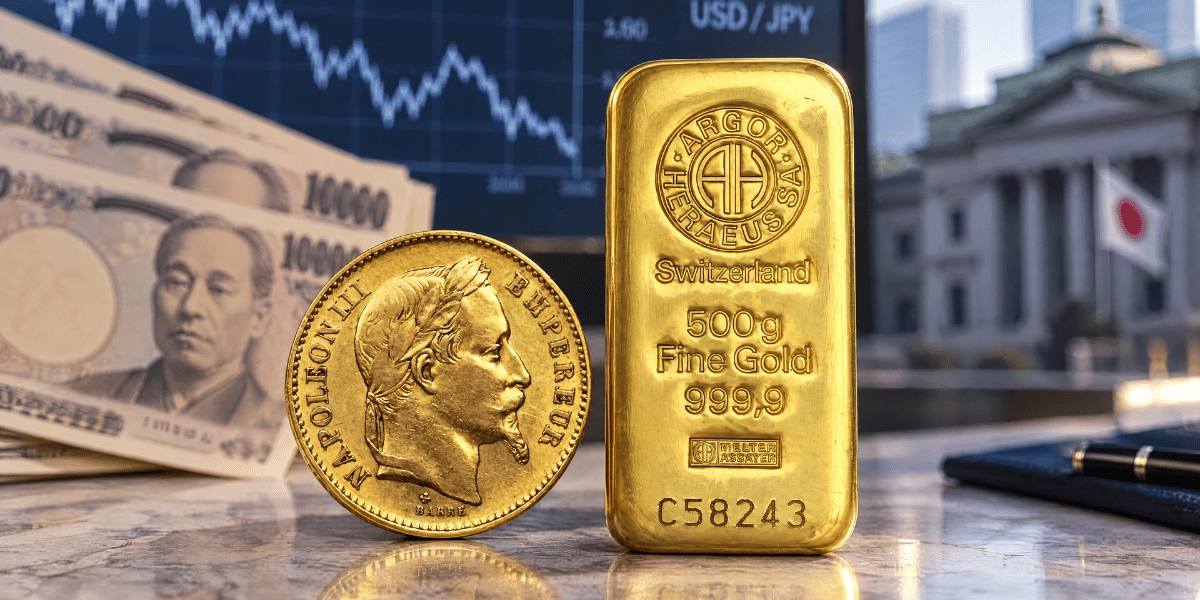
At first glance, the Bank of Japan’s decisions may seem unrelated to the gold market. However, the meeting held on September 17 and 18, 2026, deserves investors’ full attention.
By raising its key interest rate to 1.25%, the Bank of Japan is continuing the gradual normalization of its monetary policy. After several decades of very low—or even negative—interest rates, this shift calls into question one of the key mechanisms of global finance: the use of the yen as a funding currency.
The Bank of Japan’s influence on the price of gold is exerted primarily through the yen and the carry trade. When Japanese rates rise, investors must reassess the cost of positions financed in yen.
If this adjustment is gradual, its impact on the markets may be limited. However, a rapid unwinding of positions could lead to forced selling, increased risk aversion, and renewed interest in safe-haven assets. In this context, gold may find support, even if its short-term performance is likely to remain volatile.
Key takeaways
- A carry trade involves borrowing cheaply in yen to invest in assets with a higher expected return.
- Its unwinding can strengthen the yen, increase volatility and support gold through safe-haven demand.
- In the short term, sales to meet margin calls may also weigh on the metal.
- The dollar and US yields remain major drivers of gold priced in dollars.
What decision did the Bank of Japan make?
For markets, the key issue is not one isolated decision but the prospect of higher Japanese rates or a shift in perceptions of monetary policy. Less attractive yen funding reduces the appeal of strategies built on yield differentials. In addition, expectations of a stronger yen increase the repayment cost of debt denominated in that currency.
Investors may therefore rush to buy back yen and reduce risky positions. This can become self-reinforcing, since yen buying itself contributes to further appreciation.
Why does the Japanese carry trade matter?
The principle is straightforward: borrow in a low-cost currency, convert the funds into a higher-yielding currency, then buy bonds, equities or other assets. Yet expected returns do not remove foreign-exchange risk. If the yen rises sharply, the debt becomes more expensive to repay in the currency of the assets held.
Consequently, a yen reversal can prompt rapid deleveraging and affect several markets at once. The exact size of these positions is difficult to observe, notably because some exposures use derivatives or financing structures. The carry trade is therefore less an independent cause than an amplifier of financial stress.
The Yen and Gold: A Primarily Indirect Relationship
Since gold is primarily priced in dollars, the yen affects its price indirectly, particularly through its influence on the greenback and on risk aversion.
A stronger yen can contribute to a weaker dollar. In this scenario, gold and other precious metals may benefit, as a weaker dollar makes them less expensive for investors using other currencies.
However, if the yen’s rise triggers a broad market correction, gold may experience high volatility. During a liquidity shock, some investors temporarily sell their gold positions to quickly obtain cash. They may then return to the precious metal when their concerns shift toward financial stability, central banks, or systemic risk.
The Bank of Japan’s influence on the price of gold must therefore be analyzed as an evolving process. A gradual rise in Japanese interest rates will not have the same consequences as a sudden appreciation of the yen. The pace of the movement is just as important as its direction.
The Dollar: Another Key Factor for Precious Metals
The dollar remains one of the key variables to monitor in order to understand trends in the price of gold.
If Japanese rates rise while U.S. yields become less attractive, the yield spread between the two countries may narrow. This situation could support the yen and weigh on the dollar. Gold could then benefit, particularly if U.S. real yields also decline.
The outlook for September 2026, however, remains more complex, as the U.S. Federal Reserve has also raised its rates. The yield spread thus remains favorable to the dollar.
The Associated Press reports that the dollar temporarily surpassed the 157-yen mark following the Bank of Japan’s decision. This reaction shows that a rise in Japanese interest rates is not necessarily enough to trigger a sustained appreciation of the yen.
To assess the outlook for gold, investors must therefore monitor three indicators simultaneously:
- the dollar’s performance;
- U.S. real yields;
- the dollar-yen exchange rate.
A persistently strong dollar can limit gold’s gains. Conversely, a recovery in the yen coupled with a decline in U.S. real yields would create a more favorable environment for the precious metal.
Could a liquidity shock send gold prices soaring?
The weekly chart published on our website shows a two-stage trend. At midnight on September 18, 2026, a kilogram of gold cost €121,636. The price then rose to €123,041 at 11 a.m., before closing the day at €122,543.
Since the market was closed over the weekend, the chart shows this level holding steady until the start of September 21. At midnight that day, a kilogram was still worth €122,543—€907 more than at the start of September 18—representing an increase of approximately 0.75%. The rise observed following the Bank of Japan’s decision was thus maintained until the start of trading on September 21.
The trend then reversed. The price fell throughout the day on September 21, reaching €121,814 at 11:00 p.m. On September 22, after a temporary rebound to €122,536 around 2:00 a.m., the decline accelerated to €120,718 by 10:00 a.m. At 11:00 a.m., the chart showed a return to €121,446, while the main price on the page displayed €121,499.28 per kilogram at 11:02 a.m.
This timeline thus reveals an increase between the start of September 18 and the start of September 21, followed by a correction that began on the 21st and intensified on the 22nd. This does not represent a sustained surge in gold prices, but it does show that the metal initially held its ground before giving back some of its gains. For the individual investor, this sequence illustrates above all how quickly the market can shift between seeking safety, taking profits, and meeting liquidity needs. However, this alone is not sufficient to attribute the entire movement to the Bank of Japan.
Conclusion
The meeting held on September 17 and 18 marks a new stage in the normalization of Japanese monetary policy. By raising its key interest rate to 1.25%, the Bank of Japan is gradually increasing the cost of yen-denominated financing.
For the gold market, the implications extend beyond the Japanese decision itself. They lie in the transmission chain linking Japanese interest rates, the yen, the carry trade, the dollar, global liquidity, and precious metals.
A unwinding of the carry trade could support gold if it triggers a sustained rise in risk aversion or a weakening of the dollar. However, it could initially lead to selling aimed at raising cash.
Retail investors should therefore avoid jumping to conclusions. The Bank of Japan’s policy is, above all, a potential source of volatility for the price of gold—not a guarantee of an immediate rise.
By La rédaction Godot & Fils
Passionate and expert in the field of buying and selling precious metals, we put our expertise at your service to offer you in-depth analyses of gold and silver financial news. Driven by the desire to provide you with clear, reliable and relevant information, we ensure that each piece of content is both precise and concise. Our aim is to help you better understand market trends so that you can make informed decisions about your investments. Through our articles, we offer practical advice, decoding of major economic events and technical analysis to maximise your investment opportunities. Whether you are a beginner or an experienced investor, our content is designed to help you succeed in your precious metals investments. Follow us so that you don't miss out on any market developments and benefit from an expert's view of gold, silver and the economic dynamics that shape their value.
Receive the latest news by subscribing to the newsletter


 Box Maple Leaf


 10 Francs Napoleon

 Zodiac Series : Gemini 1 Oz Silver


