
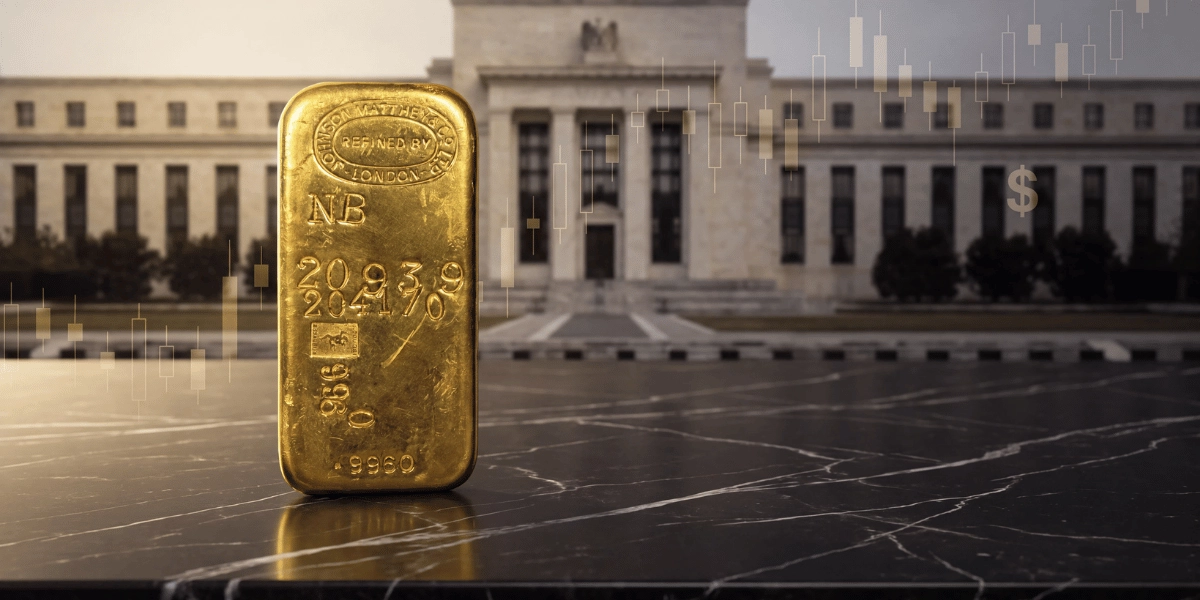
The U.S. Federal Reserve’s latest decision puts gold back at the center of asset allocation decisions. On July 29, 2026, the Fed decided to keep the target range for the federal funds rate between 3.50% and3.75%. This decision continues a cautious approach: not easing monetary policy too soon while inflation remains above the 2% target. For individual investors, the message is more nuanced than it appears. A Fed that does not cut rates may limit gold’s momentum, as the metal pays no income. But a Fed that is hesitant, facing inflationary pressures, and needing to preserve its credibility may also bolster gold’s appeal as a safe-haven asset. The question, therefore, is not simply whether rates will rise or fall. It is about understanding how rate expectations, the dollar, and confidence in monetary policy influence demand for physical gold.
Key Takeaways from the Article
- On July 29, 2026, the Fed kept its benchmark interest rate within a range of 3.50% to 3.75%. This status quo does not signal a return to an accommodative policy.
- For gold, the key factor remains the level of real interest rates. The higher they rise, the greater the opportunity cost of holding gold. If they fall, gold regains some breathing room.
- The dollar remains the other key variable. A strong U.S. dollar can weigh on gold. A weaker dollar often supports gold, whether priced in euros or dollars.
- For individual investors, physical gold continues to play a role in wealth management: diversification, a store of value, and protection against difficult market scenarios.
What the Fed Decided on July 29, 2026
On July 29, 2026, the FOMC kept the target range for the federal funds rate at 3.50% to 3.75%. The vote was not unanimous: the decision was approved by a vote of 9 to 3. This is an important point. It shows that the internal debate remains open.
The implementation note published by FederalReserve.gov also specifies that, effective July 30, 2026, the Open Market Desk must maintain the effective rate within this same range. The overnight repo rate is set at 3.75%. The overnight reverse repo rate is set at 3.50%.
For the markets, this status quo is therefore not a neutral signal. It confirms that the Fed prefers to wait. It wants to see if inflation is truly slowing down. It also wants to avoid easing financial conditions too quickly. Gold is reacting to this caution, as its price depends heavily on what investors anticipate for the coming months.
Why Fed Rates Matter So Much for Gold
Gold pays neither coupons nor dividends. It does not provide a return to its holder. When U.S. interest rates rise, bonds become more attractive. The opportunity cost of holding gold increases. In this context, some investors prefer assets that pay interest.
The reverse is also true. If the market believes the Fed will cut rates, or if real yields decline, gold can become more competitive again. The World Gold Council explains on Gold.org that an easing of rate expectations would likely benefit gold. The organization also notes that interest rates and the dollar can become headwinds if their rise exceeds expectations.
That is why gold’s reaction does not depend solely on the official decision. It depends above all on the message sent to the market. A hawkish Fed can weigh on gold in the short term. Conversely, a Fed perceived as too cautious in the face of inflation can support demand for safe-haven assets.
The Dollar: The Second Transmission Channel
The dollar plays a major role. Gold is priced globally in dollars. When the dollar strengthens, gold becomes more expensive for buyers using other currencies. This can dampen demand. When the dollar weakens, gold often finds support.
The Fed’s decisions directly influence this variable. High interest rates can support the greenback. Expectations of rate cuts can weaken it. For a French investor, the equation is twofold. It’s important to track the price of gold in dollars, but also its price in euros. Exchange rates can amplify or dampen price movements.
That is why individual investors should not view the Fed’s decision in isolation. They must consider nominal rates, real rates, the dollar, and inflation. Gold lies at the intersection of these four forces.
A Tightening Fed: Good or Bad for Gold?
A hawkish Fed isn’t automatically bad for gold. It all depends on the context. If rates rise because the economy remains strong and inflation is slowing, gold may lose some of its appeal. Investors are willing to take on more risk. They favor stocks or bonds.
But if rates remain high because inflation persists, the outlook changes. Gold can then fulfill its role as a safe-haven asset. It protects against a loss of confidence in currency. It also provides protection against more unstable scenarios: economic slowdowns, geopolitical tensions, high public debt, or market volatility.
The World Gold Council emphasizes in its 2026 scenario that the broader context matters more than the interest rate level itself. A rate hike can weigh on gold if it restores monetary credibility. It may have less of a negative impact if it raises market concerns about growth or financial stability.
What Recent Market Data Shows
The monetary policy report published in July 2026 by FederalReserve.gov indicates that markets were then anticipating an increase of about 30 basis points in the effective federal funds rate by the end of 2026, to around 4%. This suggests that investors have not ruled out further monetary tightening.
In the same report, the Fed states that the median PCE inflation projection for 2026 stands at 3.6%, compared with a long-term target of 2%. The median projection for core PCE inflation stands at 3.3%. These levels explain why the central bank remains cautious.
The Wall Street Journal reported that the August Comex Gold contract rose 1.58% on July 30, 2026, to $4,100.10 per ounce. This reaction shows that the gold market may welcome a status quo from the Fed when investors view it as a pause—or a risk of delay—in the fight against inflation.
Gold Price as of August 3, 2026
On August 3, 2026, gold was trading at €113,291.51 per kilogram. The price of an ounce of gold stood at €3,523.76. The price of an ounce of gold in dollars was quoted at $4,061.88/oz. These prices keep gold at a still-high level, despite the corrective movements observed since the highs reached at the beginning of the year.
For physical products, the 20-franc Napoleon coin was priced at €684.50 to buy and €640.00 to sell. The 1-kg gold bar was trading at around €114,980 to buy and €111,580 to sell. These spreads serve as a reminder that investors must consider not only the price but also the premium and liquidity.
The Fed’s policy environment makes this discipline even more important. If rates remain high, gold may experience periods of consolidation. If expectations of rate cuts return, it could rebound quickly. A gradual strategy helps avoid relying on a single entry point.
What strategy should a retail investor adopt?
Physical gold should be viewed as a component of one’s overall portfolio. It is not intended to replace emergency savings. Nor is it meant to be the sole driver of returns. Its role is different: to provide stability when markets become less predictable. For an individual investor, buying in stages is often the most rational approach. It helps average out the purchase price. It reduces the risk of buying in the wake of an overly rapid market reaction. It also allows you to tailor your purchases to your available budget. Liquid coins remain particularly attractive. The 20-Franc Napoleon appeals to the French market. Major international gold ounces offer global recognition. Small gold bars allow for a more gradual allocation. The 1-kg gold bar is intended for investors with already established portfolios. In all cases, it is important to compare premiums and resale terms.
What Could Drive Gold Up or Down After the Fed
Three factors could support gold. First, a decline in real interest rate expectations. Second, a weaker dollar. Finally, increased economic or geopolitical uncertainty. These three factors boost demand for safe-haven assets.
Conversely, three factors could weigh on gold: higher-than-expected U.S. interest rates; a sustained strong dollar; and a marked return of risk appetite. In this scenario, some investors might reduce their exposure to gold.
The most prudent approach, therefore, is to avoid taking anything for granted. The Fed’s recent decisions do not send a single, clear signal. Instead, they create a more tactical market. For investors, this argues for a structured, gradual allocation that is consistent with their investment horizon.
Conclusion
The Fed’s recent decisions confirm that gold remains highly sensitive to interest rate expectations, the dollar, and inflation. The decision to keep the federal funds rate between 3.50% and 3.75% on July 29, 2026, is not merely a status quo. It reflects a central bank that remains cautious in an environment where inflation continues to exceed its target.
For individual investors, this situation does not mean they should rush to buy. It means they need to understand the role of gold. Physical gold serves to diversify a portfolio, reduce dependence on financial assets, and provide protection against difficult market scenarios. In a cycle where the Fed remains at the center of the action, this function remains essential.
By La rédaction Godot & Fils
Passionate and expert in the field of buying and selling precious metals, we put our expertise at your service to offer you in-depth analyses of gold and silver financial news. Driven by the desire to provide you with clear, reliable and relevant information, we ensure that each piece of content is both precise and concise. Our aim is to help you better understand market trends so that you can make informed decisions about your investments. Through our articles, we offer practical advice, decoding of major economic events and technical analysis to maximise your investment opportunities. Whether you are a beginner or an experienced investor, our content is designed to help you succeed in your precious metals investments. Follow us so that you don't miss out on any market developments and benefit from an expert's view of gold, silver and the economic dynamics that shape their value.
Receive the latest news by subscribing to the newsletter


 EpargnOr 1oz

 5 French Francs 1959 - 1969

 Incuse Indian 1 Oz Silver


