
When current expenses account for an increasing share of income, the ability to save becomes more limited. In the second quarter of 2026, purchasing power per unit of consumption fell by 0.6% compared with the previous quarter, according to INSEE. For individuals looking to diversify their assets, the amount needed for an initial purchase of precious metals then becomes a key consideration.
Gold retains a special place in wealth management strategies, but the price of a standard coin may exceed the available budget. Silver offers a more affordable option, with coins available for just a few dozen euros. Given the decline in purchasing power, can silver become an accessible alternative to gold?
To answer this question, we must compare what budgets of €100, €500, or €1,000 actually allow for. Physical silver, small gold coins, and gradual savings open up different possibilities. The cost per gram, fees, resale conditions, and risks specific to each metal help determine their suitability.
Key Takeaways from the Article
- Purchasing power per unit of consumption fell by 0.6% in the second quarter of 2026 compared to the previous quarter. This national average does not reflect the situation of every household.
- With cash, you can buy coins for just a few dozen euros. It offers an accessible entry point into precious metals, with significant exposure to industrial trends.
- At €500 or €1,000, small-sized gold products become affordable. The price per gram of fine metal and the spread between buy and sell prices remain key factors.
- Setting aside a regular amount allows you to gradually save up for a gold coin or bar. The frequency of purchases then depends on your available budget, price trends, and any potential shipping costs.
Silver is more affordable, but follows a different logic
A silver coin costs less than a standard gold coin. This difference makes it easier to make an initial purchase and allows you to build a divisible collection: a few coins can be sold without having to part with your entire reserve.
However, this does not make silver any less risky. Demand for silver depends largely on the electronics, solar, and electrical equipment industries. The World Silver Survey 2026 estimates industrial demand at 657.4 million ounces in 2025, out of a total demand of approximately 1.13 billion ounces. Industry thus accounts for more than half of this demand.
Silver thus combines a monetary dimension with strong economic sensitivity. An industrial slowdown can weigh on its price, even when households are seeking to protect their savings. A low entry price guarantees neither stability nor automatic catch-up relative to gold.
What can you buy with €100, €500, or €1,000?
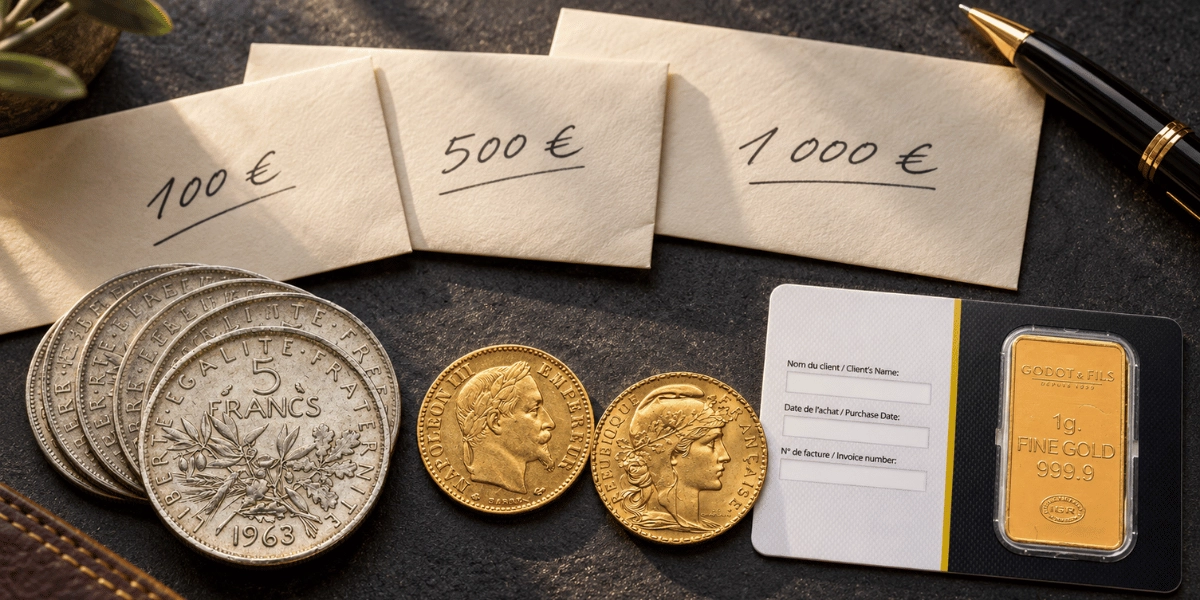
Here’s what you can get with three budgets of €100, 500 €, and 1,000 €, based on purchase prices including all taxes (excluding shipping costs), as listed on achat-or-et-argent.fr on October 27, 2026, at 10:45 a.m.: €18.50 for the 5-Franc Semeuse silver coin, €145.50 for the 1-gram gold bar, €389 for the 10-Franc Napoleon, and €710.50 for the 20-Franc Marianne Coq.
This difference between entry-level prices and risk levels prompts a practical examination of what each budget allows you to purchase. The table below helps you compare the quantities available in gold and silver, as well as the remaining balance, so you can choose a format that fits your means.
The table presents separate options for gold and silver: purchases from the same category cannot be combined. For physical products, the total corresponds to the number of coins or small bars multiplied by their unit price. The remaining balance is available in euros. Any shipping costs are not included: they may reduce the quantity available within the same budget. Prices fluctuate throughout the day, and products are subject to availability.
| Budget |
Physical Silver (Prices as of 10/27/2026, excluding shipping costs) |
Gold in small denominations (Price as of 10/27/2026, excluding shipping costs) |
| 100 € | 5 "Semeuses" 5-Franc coins: 92.50€ | The 1-gram ingot costs 145.50€ |
| 500 € | 27 "Semeuses" 5-Franc coins: €499.50 |
1 10-Franc "Napoleon" coin: €389 OR 3 1-gram ingots: €436.50 |
| 1,000 € | 54 5-Franc “Semeuses” coins: €999 |
1 “Marianne Coq” coin: €710.50 OR 2 10-Franc “Napoléon” coins: €778 |
With €100, you can purchase several coins, while the 1-gram gold bar exceeds the budget. Starting at €500, your options expand to include small coins and gold bars. With 1,000 €, buying a Marianne Coq coin still leaves 289.50 € available. It is therefore not necessary to spend the entire budget: the choice of denomination should remain consistent with your savings goal.
Comparing Fine Metal Content and Production Cost
A coin’s gross weight alone is not enough. A 12-gram “Semeuse” coin, with a fineness of 835 ‰, contains 10.02 grams of fine silver. A 3.2258-gram 10-Franc Napoleon, with a fineness of 900 ‰, contains approximately 2.90 grams of fine gold. It is this quantity that allows for a comparison of different sizes of the same metal.
The premium is the amount paid in addition to the value of the metal contained. Smaller denominations often incur higher costs per gram. As of the quote on October 27, 2026, at 10:45 a.m., a 10-Franc Napoleon coin is worth approximately 134 € per gram of fine gold, compared to 145.50 € for the 1-gram gold bar.
The difference between the purchase price and the resale price is just as important. At the same time, the “Semeuse” coin, purchased for €18.50, had a gross buyback price of €13—about 30% less than the initial cost, before any taxes. This difference varies: when you buy physical gold or silver, you cannot be certain that you will immediately recoup the full amount invested upon resale.
Investing in Gold on a Small Budget Through Gradual Purchases
To invest in gold on a small budget, you can set aside a dedicated fund and then purchase a coin or bar when the available funds allow. This approach avoids having to immediately commit several hundred euros and allows you to consolidate your purchases. The amount set aside should be consistent with your regular expenses and emergency savings.
For example, setting aside €100 per month allows you to accumulate €400 in four months. At the reference price of €389 recorded on October 27, 2026, this amount would be enough to purchase a 10-Franc Napoleon coin, with €11 remaining before any shipping costs. However, the coin’s price may have changed in the meantime: the time required to acquire it remains variable.
This method allows you to choose a pace that fits your income and to compare options before each purchase. Any shipping costs must be factored into the budget. Invoices and product references should be kept to document purchases. The savings set aside do not represent an exposure to gold until the time of purchase; therefore, the regularity of payments does not guarantee either a specific purchase price or a specific return.
Conclusion: Choose a Method Suited to Your Objective
Bullion can provide access to precious metals with a modest investment. It offers divisibility, but its sensitivity to market fluctuations and transaction spreads must be taken into account. For exposure to gold, small coins and gradual purchases offer alternative avenues. When purchasing power is tight, the priority is to preserve available savings, then to choose a sustainable pace and keep total costs under control. The best entry point is thus judged over the long term, rather than based solely on the price of a single coin.
By La rédaction Godot & Fils
Passionate and expert in the field of buying and selling precious metals, we put our expertise at your service to offer you in-depth analyses of gold and silver financial news. Driven by the desire to provide you with clear, reliable and relevant information, we ensure that each piece of content is both precise and concise. Our aim is to help you better understand market trends so that you can make informed decisions about your investments. Through our articles, we offer practical advice, decoding of major economic events and technical analysis to maximise your investment opportunities. Whether you are a beginner or an experienced investor, our content is designed to help you succeed in your precious metals investments. Follow us so that you don't miss out on any market developments and benefit from an expert's view of gold, silver and the economic dynamics that shape their value.
Receive the latest news by subscribing to the newsletter


 Britannia 1/4 Once Gold


 Zodiac Series : Aquarius 1 Oz Silver


