
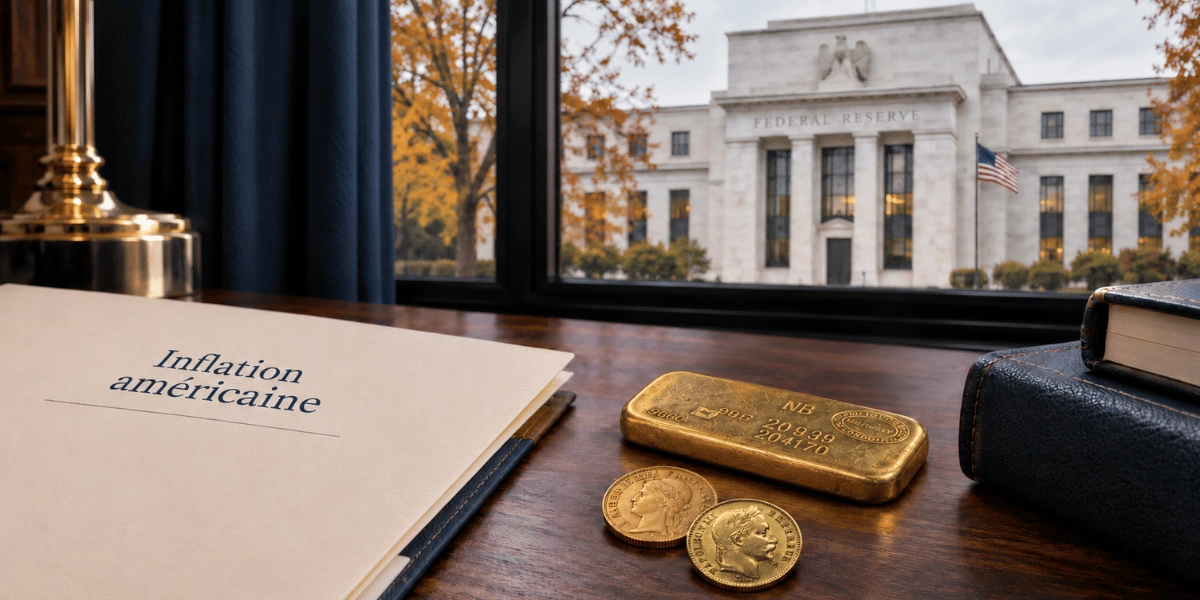
Gold’s rebound following the U.S. elections rests on a still-fragile balance. The decline in the dollar and bond yields has supported the metal, but this trend remains sensitive to inflation and monetary policy outlooks. The midterm election results alone are not enough to establish a lasting trend when the Federal Reserve must still balance price stability with economic activity.
The next key event is scheduled for Tuesday, November 10, 2026, at 2:30 p.m. Paris time (8:30 a.m. in Washington). On that date, the Bureau of Labor Statistics will release the U.S. Consumer Price Index (CPI) for October. An upward surprise could reignite expectations of monetary tightening; more moderate inflation could dampen them.
Can gold’s rally withstand this new test? To answer this, we must link U.S. inflation and the price of gold through three variables: Fed rate expectations, real yields, and the dollar. For French investors, a fourth factor comes into play: the conversion of prices into euros.
Key Takeaways from the Article
- The October 2026 CPI is scheduled to be released on Tuesday, November 10, at 2:30 p.m. Paris time. The deviation from expectations will matter more than the figure itself.
- Higher inflation could reinforce the scenario of a Fed rate hike in December, support the dollar, and weaken gold.
- A positive surprise could have the opposite effect, though it would not guarantee a rise in gold prices or rule out future monetary tightening.
- Real interest rates, adjusted for expected inflation, remain key: a decline in the CPI alone is not enough to determine their direction.
- For a French investor, currency exchange rates can cushion or reduce fluctuations in the price of gold per ounce in dollars. The price of coins and bars also includes their premium.
After the midterms, a rebound already put to the test
On November 4 and 5, gold benefited from a weaker dollar and a decline in U.S. yields, in the wake of the Democratic victory. Investors reassessed the fiscal and inflation outlook, while the decline in oil prices helped ease some concerns about inflation.
On Friday, November 6, however, the release of stronger-than-expected U.S. jobs data weighed on gold, bolstering the dollar and yields. This reversal illustrates the fragility of the trend: economic data can quickly override the political interpretation of the election results.
October 2026 CPI: Understanding the Surprise and Its Breakdown
In September, consumer prices rose 0.6% month-over-month and 3.7% year-over-year. Excluding food and energy, the increase was 0.3% month-over-month. These figures serve as a point of comparison, not a forecast for October.
It will be important to distinguish between headline inflation and core inflation, which excludes energy and food prices, among other items. A decline in inflation driven mainly by falling gasoline prices would be a positive sign, but it would still be insufficient if prices for services and housing continued to rise sharply. On the other hand, a slowdown in prices across several sectors of the economy would be a more encouraging sign of a sustained decline in inflation.
Even if inflation slows compared to September, financial markets may react negatively if the decline is smaller than expected. It will therefore be necessary to compare the published figures with economists’ forecasts—both month-over-month and year-over-year—and then examine the various price categories to better understand inflation trends.
Fed in December: A Decision Still Up in the Air
On October 28, the Fed kept its target range for the federal funds rate at 3.75% to 4%. Its next monetary policy meeting is scheduled for December 8 and 9. Next Tuesday’s CPI report will help inform this decision, though it won’t determine it on its own. The timing adds to the stakes: the November CPI is expected on December 10, after this meeting. The November figure will therefore be the last CPI data available before the decision.
Higher-than-expected inflation—especially core inflation—could reinforce the likelihood of another rate hike. Bond yields could then rise, making interest-bearing investments more attractive relative to gold, which pays no interest.
A positive surprise could ease this pressure. However, it would not automatically mean a rate cut: employment, consumer spending, and other statistics will remain key factors. Furthermore, the Fed’s inflation target is based on the PCE index, which is distinct from the CPI.
Why Real Interest Rates Matter More Than the CPI Alone
Gold can suffer from high inflation if it leads to a more restrictive monetary policy. Its role as a hedge against inflation therefore does not guarantee a rise in price every time inflation accelerates.
The relationship with real interest rates helps explain this paradox. Put simply, these yields correspond to nominal rates minus expected inflation over the same time horizon. When they rise, the opportunity cost of holding gold tends to increase.
Lower inflation therefore does not automatically favor gold. If inflation expectations fall more sharply than nominal yields, real rates may rise. It will be necessary to monitor the bond market’s reaction rather than drawing conclusions based solely on the CPI.
The Dollar and Gold: Two Reactions to Track Together
A higher CPI could support the dollar if markets anticipate higher U.S. interest rates. Gold, priced in this currency, would then become more expensive for some foreign buyers, which could dampen demand and put further downward pressure on its price.
Conversely, a weaker dollar could go hand in hand with easing yields and support the metal. If the figures meet expectations or send mixed signals, the reaction could be limited or quickly reversed. Investor positioning and geopolitical risks can also alter this outlook.
In France, think in terms of euros and real purchase prices
The price per ounce in euros is calculated by dividing the price in dollars by the EUR/USD exchange rate. If the dollar rises against the euro following a high CPI reading, the exchange rate can offset a decline in the price of gold in dollars for French investors.
Conversely, a rise in the price of gold accompanied by a stronger euro may result in a more modest gain in euros. Any forecast for gold in November must therefore specify the currency.
Finally, for physical gold, it is important to examine the product’s premium, fees, and buyback terms. A change in the international price does not necessarily translate exactly into the price of a coin or bar.
Conclusion
The CPI could undermine the post-midterm rebound if it reinforces expectations of rate hikes, pushes up real yields, and supports the dollar. More moderate inflation would offer a potentially more favorable environment, though it would not guarantee sustained growth. For French investors, the key factors to consider are the statistical surprise, the monetary policy response, and currency movements, before examining the price of the physical commodity.
By La rédaction Godot & Fils
Passionate and expert in the field of buying and selling precious metals, we put our expertise at your service to offer you in-depth analyses of gold and silver financial news. Driven by the desire to provide you with clear, reliable and relevant information, we ensure that each piece of content is both precise and concise. Our aim is to help you better understand market trends so that you can make informed decisions about your investments. Through our articles, we offer practical advice, decoding of major economic events and technical analysis to maximise your investment opportunities. Whether you are a beginner or an experienced investor, our content is designed to help you succeed in your precious metals investments. Follow us so that you don't miss out on any market developments and benefit from an expert's view of gold, silver and the economic dynamics that shape their value.
Receive the latest news by subscribing to the newsletter


 Half Sovereign




 10 Guilders


