
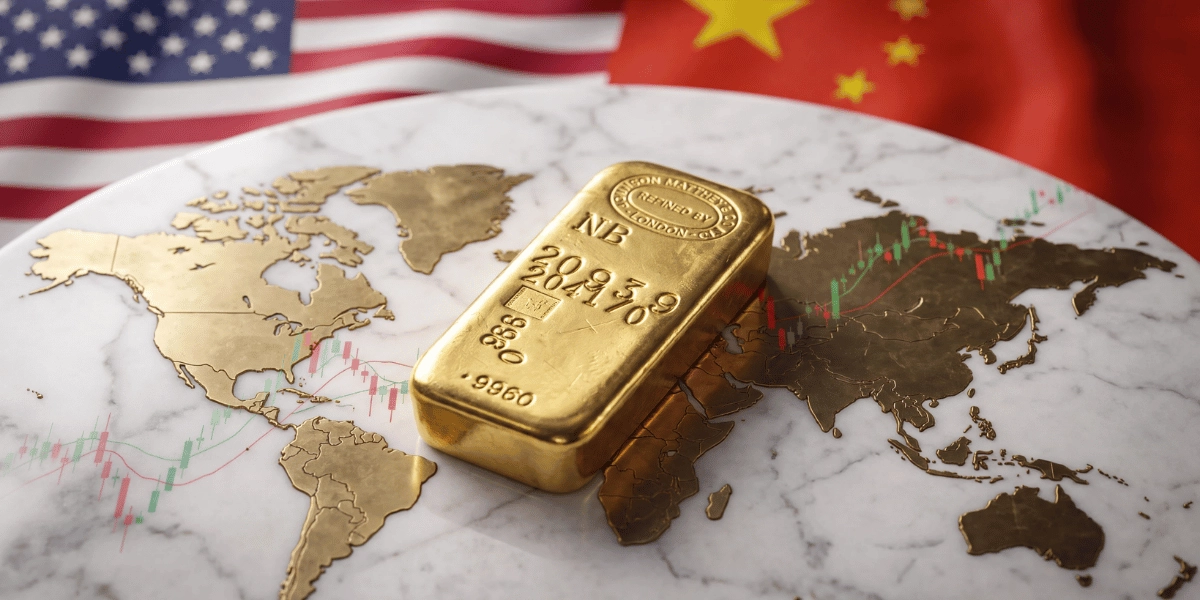
On July 24, 2026, Donald Trump imposed a new round of tariffs. About 60 economies are targeted, including China, Japan, Australia, and the European Union. As of 12:01 a.m. Paris time, certain products entering the United States are subject to a 10% or 12.5% surcharge. These measures replace temporary surcharges that have expired. Beijing strongly opposes the move. Brussels is somewhat relieved, as the new regime remains within the cap negotiated with Washington. For the markets, the signal is clear: the trade war is back in the spotlight. It’s not just affecting trade flows. It can also reignite imported inflation, squeeze corporate margins, and drive investors toward tangible assets. This is where gold regains its appeal. It remains a safe-haven asset when trade rules become unstable and confidence erodes.
Key Takeaways from the Article
- On July 24, 2026, La Tribune reported on a new round of U.S. tariffs imposed by Donald Trump. About 60 economies are affected.
- This announcement puts the trade war back in the spotlight. It creates the risk of higher prices, pressure on profit margins, and less predictable growth.
- The link between war and gold is well known. The link between trade policy, imported inflation, and precious metals is much less so. Yet it is essential.
- In this environment, physical gold is reclaiming its role as a safe-haven asset. It does not promise a return. It offers a tangible, liquid reserve that is independent of financial markets.
The trade war is back in the spotlight
Markets often keep a close eye on military conflicts. They also react to trade wars. The difference is less obvious, yet it is powerful. A tariff changes the price of goods. It also alters companies’ expectations. It can weigh on margins. It can slow trade. Finally, it can fuel inflation.
That is why the topic of Trump’s tariffs is once again a focus of investor research. The announcements made on July 24, 2026, are not isolated incidents. La Tribune notes that they follow temporary surcharges implemented earlier this year. USTR.gov also lists several presidential tariff measures. Foreign trade is thus once again becoming a key political tool.
For gold, this context matters. The yellow metal does not rise simply because a tariff is imposed. It rises when that tariff creates lasting uncertainty. Investors then seek to reduce their exposure to risky assets. They turn back to safe-haven assets. Physical gold becomes a simple answer to a complex situation.
Tariffs and Imported Inflation: The Underestimated Link
A tariff is an additional cost. This cost can be absorbed by the company. It can also be passed on to the end customer. In either case, it creates tension. If the prices of certain imported goods rise, inflation may pick up again—even partially, even gradually.
This mechanism directly affects precious metals. Many investors understand the link between geopolitical crises and gold. They are less likely to grasp the connection between trade wars, gold, and imported inflation. Yet it makes sense. If currency loses purchasing power, tangible assets become more sought after. Gold is one of the first choices that comes to mind.
Gold is not a perfect hedge against every price increase. Its value can fluctuate significantly. But it retains a rare quality: it does not depend on an issuer. It is not a debt. It is not a bank’s liability. In a world where prices and rules change rapidly, this independence matters.
Why Does Gold Remain a Safe-Haven Asset?
Gold is a safe haven because it inspires confidence in times of uncertainty. This role does not stem from a promise of returns. It stems from its history, its scarcity, and its global liquidity. Investors use it to balance their portfolios when markets become volatile.
The World Gold Council notes on Gold.org that gold is driven by several factors, including risk and uncertainty. Currency dynamics also play a role. A trade war can therefore support gold through multiple channels at once. It can create volatility. It can undermine confidence. It can also complicate the work of central banks.
Being a safe-haven asset does not guarantee a rise in value. This is important. Gold may correct if the dollar strengthens. It may also suffer if real interest rates rise. But during a period of trade tensions, it retains a useful function. It reduces the dependence of a portfolio on an overly optimistic economic scenario.
Why Physical Gold Appeals More to Individual Investors
An investor can buy gold in several ways. They can invest through an ETF. They can buy mining stocks. They can also buy coins or bars. In a trade war, physical gold has a strong psychological advantage. It is tangible. You hold it directly. It does not rely on a trading platform or a financial issuer.
This aspect reassures individual investors. A Napoleon coin, a Krugerrand, a Maple Leaf, or a certified bar is easy to understand. They have a market. They can be passed down. They can be resold. Their price depends on the price of gold, but also on the premium and the liquidity of the format.
This is where strategy becomes essential. It’s not enough to buy gold just because Trump’s tariffs are making headlines. You have to look at the entry price. You have to compare premiums. You have to think about storage. You also have to maintain a reasonable allocation. Physical gold provides better protection when purchased with discipline.
Physical demand is already strong
The World Gold Council reports in *Gold Demand Trends Q1 2026* that global demand for bars and coins rose 42% year-over-year. It reached 474 metric tons in the first quarter of 2026. This is a strong signal. Retail investors are no longer content to simply watch gold; they are returning to physical forms of the metal.
The Gold.org website also notes that demand has increased in the United States and Europe. This shows that the trend is not limited to Asia. Western markets are also seeking protection. In this context, the trade war may act as a catalyst. It adds another reason to take an interest in physical gold.
Rising prices do not negate this logic. They simply require investors to be more selective. When gold prices are already high, gradual buying becomes preferable. It helps average out the purchase price and limits decisions made in the heat of the moment.
Gold Prices as of July 27, 2026
On July 27, 2026, gold was trading at €115,436.93 per kilogram. The price of an ounce of gold was €3,590.49, silver was €1,669.788 per kilogram, platinum was €46,256.89 per kilogram, and palladium was €36,314.59 per kilogram. For physical products, the 20-franc Napoleon coin was priced at €697.50 for buying and €640.00 for selling. The 1-kg gold bar was trading at around €117,157.00 to buy and €113,694.00 to sell. These figures highlight a key point. The spot price alone is not enough. An investor must consider the premium, the bid-ask spread, and market depth. During times of market volatility, certain formats may see increased demand. Their premium may then widen.
Buying Gold Now: Caution or Opportunity?
The “gold trade war” is a powerful theme. It can support demand. But it does not justify an impulsive purchase. Tariff announcements often trigger rapid reactions. Markets may then correct. Retail investors should therefore avoid the trap of trying to time the market perfectly.
The best approach remains a gradual one. An allocation built in stages reduces the risk of buying at the peak of a media frenzy. It also allows you to tailor the amount invested to your budget. Physical gold should remain a diversification tool. It should not replace emergency savings.
Liquid coins remain particularly attractive. The Napoleon appeals to the French market. Major international gold coins are recognized worldwide. Smaller gold bars may be suitable for incremental purchases. Larger gold bars are intended for investors with already established portfolios.
Factors That Can Hinder the Safe-Haven Effect
Gold never moves in just one direction. Even amid trade tensions, several factors can curb its rise. A strong dollar can weigh on the price in dollars. High real interest rates can make bonds more attractive. A rapid de-escalation of trade tensions can also reduce the risk premium.
It is therefore important to avoid oversimplifying the situation. Trump’s tariffs and gold do not follow an automatic equation. They create a context. This context becomes favorable if investors perceive a lasting risk of inflation, volatility, and trade fragmentation.
This is precisely why physical gold should be viewed as a form of wealth insurance. You don’t buy insurance to speculate on the coming week. It is part of a long-term strategy. It protects against scenarios beyond your control.
Conclusion
The new tariffs announced by Donald Trump on July 24, 2026, have brought the trade war back to the forefront of economic news. They target some 60 economies. They also reignite a key question for investors: What should one do when the rules of global trade become less stable?
Physical gold offers a clear—though not miraculous—solution. It can benefit from a resurgence of imported inflation, rising uncertainty, and increased demand for safe-haven assets. But it must be purchased strategically. For an individual investor, the goal is not to react to every news announcement. It is to build a portfolio of tangible, liquid assets that is consistent with one’s overall wealth.
By La rédaction Godot & Fils
Passionate and expert in the field of buying and selling precious metals, we put our expertise at your service to offer you in-depth analyses of gold and silver financial news. Driven by the desire to provide you with clear, reliable and relevant information, we ensure that each piece of content is both precise and concise. Our aim is to help you better understand market trends so that you can make informed decisions about your investments. Through our articles, we offer practical advice, decoding of major economic events and technical analysis to maximise your investment opportunities. Whether you are a beginner or an experienced investor, our content is designed to help you succeed in your precious metals investments. Follow us so that you don't miss out on any market developments and benefit from an expert's view of gold, silver and the economic dynamics that shape their value.
Receive the latest news by subscribing to the newsletter


 Britannia 1/10 Once Gold

 1 Kilo Bar

 Double Eagle


