
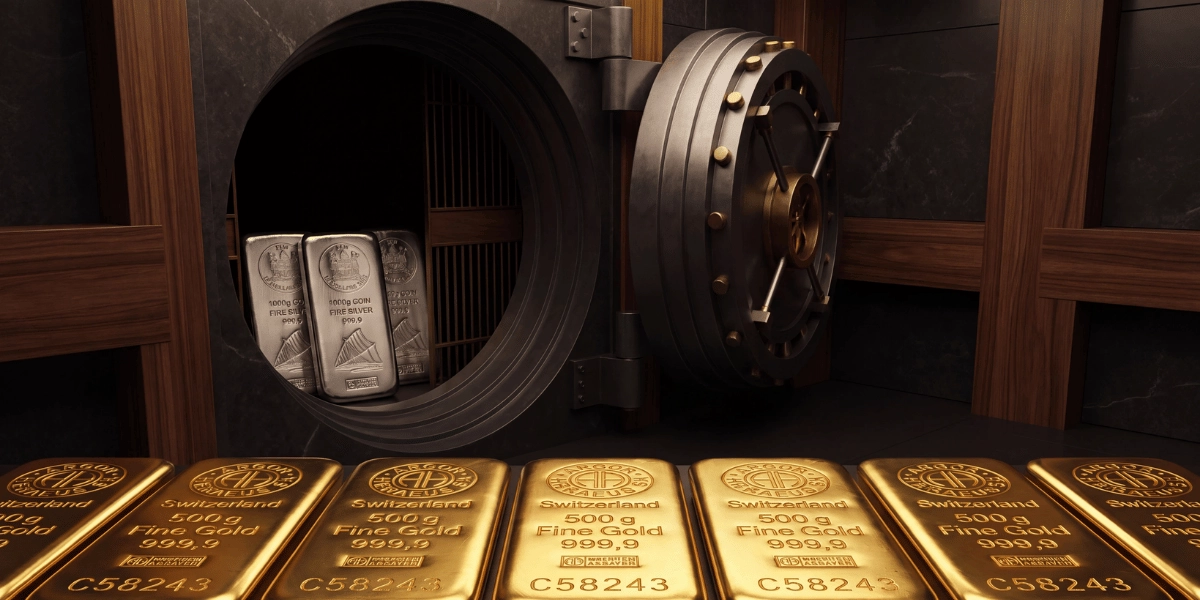
If gold and silver are both precious metals, why do central banks accumulate the former and almost never the latter? The answer is historical, monetary, and practical. For centuries, silver circulated as currency. It financed trade, empires, and bimetallic systems. But the 19th century gradually established gold as the international standard, and the 20th century transformed gold into an official reserve asset. Even after the dollar’s convertibility into gold ended in 1971, gold remained in central bank vaults. Silver, on the other hand, shifted to a primarily industrial and financial role. Understanding this distinction helps avoid a common mistake: believing that all precious metals play the same role in a portfolio. It also helps distinguish between a monetary reserve, wealth protection, and a cyclical investment.
Key Takeaways from the Article
- Central banks buy gold because it remains a recognized, liquid, universal monetary asset with no counterparty risk.
- Silver has indeed played a major monetary role throughout history, but it has gradually been replaced in official reserves by gold and, later, by international currencies.
- The World Gold Council notes that gold accounts for about one-fifth of all mined gold held by central banks and official institutions.
- For a retail investor, the difference is crucial: gold is viewed as an institutional wealth reserve, whereas silver is more dependent on industry, the economic cycle, and private investment demand.
From Silver Currency to Gold Reserves
Historically, silver was not a marginal player. For a long time, it was at the heart of trade, in the form of coins, commercial payments, and bimetallic systems. Gold, which is rarer and more concentrated in value, was used primarily for large-scale settlements and sovereign reserves.
The shift occurred with industrialization, the rise of international trade, and the search for a more stable standard. Governments favored a dense metal that was easy to store, universally recognized, and available in limited quantities.
This distinction remains crucial. A central bank is not merely seeking a precious metal; it is seeking a reserve asset. In this regard, gold retains a clear advantage: it concentrates a great deal of value, trades on a deep market, and is not dependent on any single issuer.
Why Gold Is Better Suited for Official Reserves
Official reserves must underpin a country’s credibility, reassure the markets, and diversify foreign assets. They must also remain accessible in times of crisis.
Central banks hold about one-fifth of all mined gold. Gold remains sought after for its safety, liquidity, and return profile. These qualities explain its enduring presence on official balance sheets.
The World Gold Council’s 2026 survey confirms this preference. After four years of average annual purchases of nearly 1,000 metric tons, 89% of the central banks surveyed anticipate an increase in global gold reserves over the next twelve months. The reasons cited include diversification, inflation, geopolitical risk, and performance during crises.
Why Silver Is No Longer a Core Asset
Silver has real qualities. It is tangible, scarce, and sought after for many uses. But it is less well-suited to the constraints of a central bank.
The first limitation is logistical. Storing an equivalent value requires much more silver than gold. Insurance, transportation, and storage costs rise rapidly. For a national institution, this becomes a structural issue.
The second limitation stems from the market. Silver is heavily dependent on industrial demand. Industrial manufacturing remains a major component of the global silver market, with applications in solar energy, electronics, and various other technologies. This aspect can support its potential. It also makes its price more cyclical.
The third limitation is monetary. The IMF reports official foreign exchange reserves by currency. Gold is treated separately as a monetary reserve asset. Silver no longer holds this central status in modern statistics.
A Useful Perspective for the Individual Investor
For savers, gold and silver serve different purposes. Gold is primarily an asset for wealth preservation. It helps weather currency crises, geopolitical tensions, and periods of mistrust in currencies.
Silver is more of an offensive investment. It can benefit from an industrial rebound, renewed investor interest, or a catch-up rally relative to gold. But it is also more volatile, a smaller market, and more exposed to the global economic cycle.
Why Central Banks Still Favor Gold in 2026
The year 2026 confirms this underlying trend. Central banks want to reduce their dependence on the dollar, diversify their official reserves, and hold assets that are accepted under all circumstances. As a result, net purchases by central banks reached 289 metric tons during the second quarter of 2026.
Central banks may monitor silver and track its industrial role. But they do not currently regard it as a pillar comparable to the precious metal gold.
Conclusion
Central banks buy gold because it remains a global monetary asset. They do not buy silver—or do so only to a very limited extent—because silver has fallen out of the core of the official reserve system. History explains this choice. Logistics reinforce it. International liquidity confirms it.
For the individual investor, this distinction is valuable. Gold serves as a cornerstone of a wealth-building strategy. Silver can complement this strategy with a more dynamic—but also more cyclical—profile. Both metals have their place. They simply play different roles.
By La rédaction Godot & Fils
Passionate and expert in the field of buying and selling precious metals, we put our expertise at your service to offer you in-depth analyses of gold and silver financial news. Driven by the desire to provide you with clear, reliable and relevant information, we ensure that each piece of content is both precise and concise. Our aim is to help you better understand market trends so that you can make informed decisions about your investments. Through our articles, we offer practical advice, decoding of major economic events and technical analysis to maximise your investment opportunities. Whether you are a beginner or an experienced investor, our content is designed to help you succeed in your precious metals investments. Follow us so that you don't miss out on any market developments and benefit from an expert's view of gold, silver and the economic dynamics that shape their value.
Receive the latest news by subscribing to the newsletter




 10 Francs Napoleon

 Maple Leaf 1 Oz Platine


