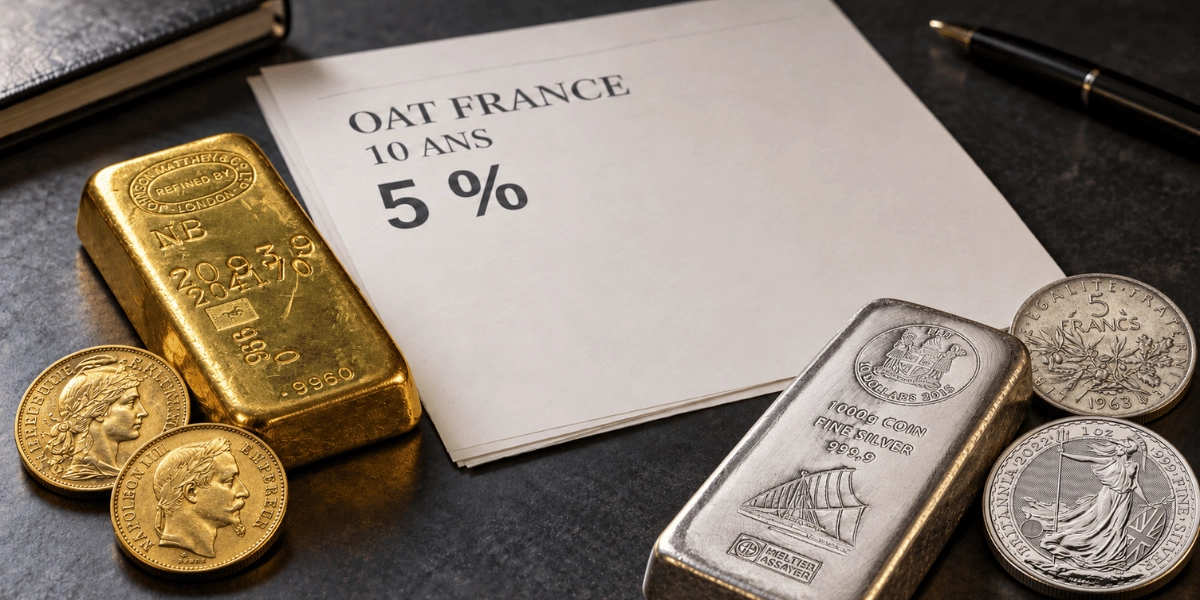
French bonds are once again offering higher returns. For investors, the question arises: why buy gold or silver, which pay no interest, when a loan to the government can offer a return of nearly 5%? To compare these investments, one must consider not only their returns but also the risks involved.
The yield on the 10-year French OAT briefly exceeded 5% on October 21, 2026, its highest level since July 2002. The trend continued, peaking at 5.1415% on October 22.
This rate is eye-catching, but it’s not enough to determine the best investment. Bonds, gold, and silver serve different purposes. The length of time you can hold your investment, price movements, and your ability to withstand a decline are just as important. To make a choice, you must first understand what you’re getting with each option.
Key Takeaways from the Article
- The yield on the 10-year French government bond exceeded 5% on October 21, 2026, then reached 5.14% the following day. This figure is stated before fees and taxes.
- Buying an OAT means lending money to the French government. You generally earn interest, but you may lose money if you sell before the maturity date.
- Inflation erodes the purchasing power of your investment: a 5% yield therefore does not necessarily represent a real gain of 5%.
- Physical gold pays no interest. When held directly, however, it is not contingent on any promise of repayment.
- Silver is more dependent on industrial demand. Its price can fluctuate more sharply than that of gold.
An OAT is a loan to the French government
OATs, or Treasury-equivalent bonds, enable the government to raise funds. Buying one is equivalent to lending money to the government. In return, the government commits to paying the scheduled interest, known as “coupons,” and then to repaying the principal amount on the specified date.
The advertised yield of 5% takes into account the bond’s purchase price, interest payments, and the final redemption amount. It does not, therefore, mean that all OATs pay a 5% coupon. The actual return also depends on fees, taxes, and—if you reinvest the interest received—the rate at which you do so.
Payments depend on the government’s ability to meet its obligations. This is known as sovereign risk: the risk that a country will encounter difficulties in repaying its debt. A higher yield may, in particular, reflect increased investor concern about public finances.
Can you sell your bond without losing money?
You can sell an OAT before its maturity date, but its price fluctuates. The AMF explains the relationship between interest rates and bond prices: when new bonds offer higher yields, older fixed-rate bonds become less attractive and their prices fall.
If you have to sell at that time, you may receive less than your purchase price. Holding onto the bond until maturity allows you to avoid having to accept this market price, provided the government honors its obligations. This requires being able to tie up the money for the entire term.
A 5% return does not mean a 5% increase in purchasing power
Inflation refers to the general rise in prices. It reduces what you can buy with the same amount of money. The ECB therefore distinguishes between the stated return and the return after inflation, also known as the real return.
Let’s consider a simple example: an investment yields 5% over the course of a year, while prices rise by 3%. The gain in purchasing power is then close to 2%, before fees and taxes. Over ten years, future inflation remains unknown: a rate that seems attractive today may therefore turn out to be less appealing once rising prices are taken into account.
Physical gold: no interest, but no borrower
When you hold a gold coin or bar directly, you own the metal itself. You aren’t lending anything to a government or a company. The World Gold Council highlights this absence of credit risk—in other words, the risk that a borrower might default.
On the other hand, gold pays no interest, and its price can fall. Your return depends on the amount you receive when you sell it, after any fees and taxes. It can help diversify your savings, though it offers no guarantee of profit or immediate protection against inflation.
Investments that pay higher interest rates may make gold less attractive. However, its price also depends on confidence in the economy, investor buying activity, and changes in interest rates and the value of the dollar. Finally, you must take steps to safeguard your gold against theft or loss. If you entrust it to a professional, verify your ownership rights and the terms for retrieving it.
Why does silver react more strongly to the economy?
Physical silver also does not pay interest. As with directly held gold, you do not depend on repayment from a borrower. But silver is used much more widely in industry: electronics, automobiles, solar panels, and electrical grids.
According to the World Silver Survey 2026, industrial uses accounted for more than half of global silver demand in 2025. However, this demand fell by 3% that year, largely because solar panel manufacturers reduced their silver requirements.
When economic activity slows down or manufacturers use less of the metal, its price can suffer. Silver therefore remains more closely tied to the ups and downs of the economy. The World Gold Council’s comparison of gold and silver also highlights silver’s greater price volatility. It does not serve the same protective role as gold.
OATs or Physical Gold: Also Compare Ease of Resale
The ease with which an investment can be resold is called its liquidity. OATs are traded on an organized market, which makes them easier to sell, though this does not guarantee a favorable price.
For coins and bullion, compare the purchase price to the buyback price offered. The difference may include a premium over the metal’s value. Transportation, storage, and any appraisal fees also factor in. For the same value, silver requires more space than gold.
Ultimately, the choice depends on your goal: earning interest with an OAT, diversifying your savings with physical gold, or accepting greater price fluctuations with silver. These investments can complement one another. The 5% rate is worth considering in light of your investment horizon and the risks already present in your portfolio.
Conclusion
A hypothetical 5% bond yield does not make gold or silver irrelevant; equally, metals cannot replace a bond’s contractual income. A suitably chosen bond may meet a need for predictable payments at a known date, provided the investor accepts issuer risk and understands its resale price. Physical gold serves a different diversification purpose without relying on a borrower, but pays no coupon and fluctuates in price. Silver adds greater exposure to industrial demand.
The decision therefore returns to the starting point: compare an advertised yield with what the savings must actually achieve. Time horizon, purchasing power, costs and potential resale matter more than a single figure. Giving different assets different roles can make more sense than seeking one winner for every situation.
By La rédaction Godot & Fils
Passionate and expert in the field of buying and selling precious metals, we put our expertise at your service to offer you in-depth analyses of gold and silver financial news. Driven by the desire to provide you with clear, reliable and relevant information, we ensure that each piece of content is both precise and concise. Our aim is to help you better understand market trends so that you can make informed decisions about your investments. Through our articles, we offer practical advice, decoding of major economic events and technical analysis to maximise your investment opportunities. Whether you are a beginner or an experienced investor, our content is designed to help you succeed in your precious metals investments. Follow us so that you don't miss out on any market developments and benefit from an expert's view of gold, silver and the economic dynamics that shape their value.
Receive the latest news by subscribing to the newsletter


 Australian Nugget Monster Box


 Zodiac Series : Capricorn 1 Oz Silver