
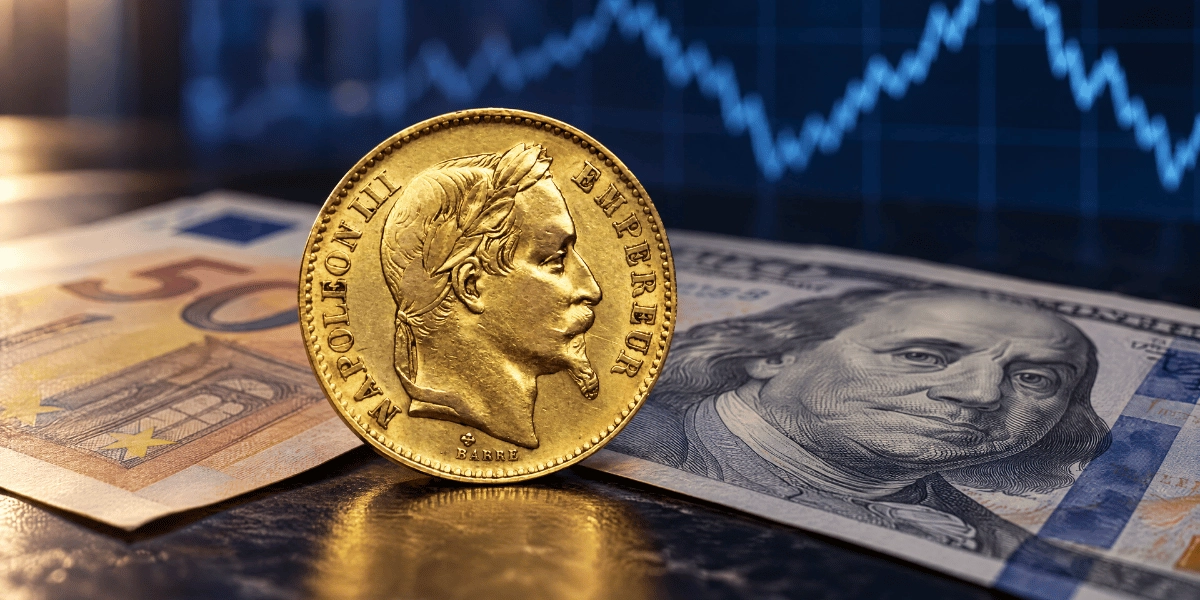
The European Central Bank’s (ECB) decision on September 10, 2026, is not limited to interest rates. For French investors with exposure to gold, it also brings the foreign exchange market back into the spotlight. The ECB raised its deposit rate by 25 basis points, to 2.50%, for the second time this year. At the same time, the euro weakened against the dollar, and gold ended the week under pressure.
This situation raises a key question: for an investor buying gold in euros, is currency risk now just as significant as the price per ounce?
The answer is yes, at least in the short and medium term. This is because the return on gold denominated in euros depends on two variables: the price per ounce in dollars and the EUR/USD exchange rate.
Key takeaways from the article:
The ECB raised its interest rates by 25 basis points, bringing the deposit rate to 2.50%, amid persistent inflation.
- For a French investor, the price of gold depends on the price per ounce in dollars and the EUR/USD exchange rate.
- Gold in euros = price in dollars ÷ EUR/USD.
- A weaker euro can support gold even if its price in dollars falls.
- A stronger euro, on the other hand, can reduce—or even negate—gold’s performance.
- A 5% rise in the price of gold can thus be wiped out in euros.
- After the ECB, the EUR/USD exchange rate deserves just as much attention as the price per ounce.
- You need to keep an eye on gold, the euro, the Fed, and the ECB
The ECB takes a tougher stance in the face of inflationary pressures
The ECB has decided to raise its deposit rate from 2.25% to 2.50%, its refinancing rate from 2.40% to 2.65%, and its marginal lending rate from 2.65% to 2.90%. The central bank justifies this decision by citing the rise in inflation, largely fueled by the energy shock linked to geopolitical tensions.
The new projections highlight the scale of the problem: the ECB now forecasts average inflation of 3.0% in 2026, 2.5% in 2027, and 2.1% in 2028. At the same time, it raised its growth forecast to 0.9% in 2026 and 1.4% in 2027.
The decision also came as a surprise due to its relatively restrictive nature. European bond yields rose sharply following the announcement, as markets priced in a greater likelihood of further rate hikes.
For gold, the mechanism is twofold. Higher interest rates can make bond investments more attractive compared to an asset that pays no interest. But a more restrictive ECB can also affect the value of the euro against the dollar. And it is this second effect that is of particular interest to French savers.
Gold in Dollars: The Number Alone Is No Longer Enough
Gold is quoted internationally in dollars. To determine its value in euros, you must therefore perform a conversion:
Gold in euros = gold price in dollars ÷ EUR/USD.
On September 10, the ECB’s reference exchange rate for the euro was 1.1616 dollars per euro.
On September 11, Reuters reported a spot price for gold of around $4,351.97 per ounce, following a weekly decline of nearly 2%.
At this exchange rate, one ounce is therefore worth approximately:
4,351.97 ÷ 1.1616 = 3,746.53 euros.
It is this price in euros that really matters for a French investor who is not hedged against exchange rate risk.
When the Dollar Cushions Gold’s Decline
The trading session following the ECB’s decision provides a concrete example. After the announcement, the euro fell by about 0.3% to 1.159 dollars, while European bond markets reacted sharply.
For a French investor, a decline in the euro against the dollar can offset a decline in the price of gold expressed in dollars.
Let’s imagine an ounce of gold falling from $4,400 to $4,312, a 2% decline. If, at the same time, the EUR/USD exchange rate falls from 1.16 to 1.13, the value in euros changes as follows:
before: 4,400 / 1.16 = 3,793 €; after: 4,312 / 1.13 = 3,816 €.
Gold loses 2% in dollars but gains about 0.6% in euros.
The dollar therefore acts as a buffer in this scenario.
Conversely, the euro could offset the rise in gold prices
The phenomenon works the other way around as well.
Suppose gold rises 5% in dollar terms, from $4,000 to $4,200 per ounce. If, at the same time, the euro appreciates by 5% against the dollar, the EUR/USD exchange rate rises from 1.16 to 1.218.
The starting price is:
4,000 / 1.16 = 3,448 €
The new price becomes:
4,200 / 1.218 = 3,448 €
Result: +5% for gold in dollars, but virtually 0% for the French investor.
The exchange rate therefore completely offset the increase in the price per ounce.
What if both markets move in the same direction?
The risk becomes even more apparent when both gold and the dollar move against the European investor.
Let’s consider a 5% rise in the price of gold in dollars, but a 3% appreciation of the euro. The return in euros is not 5%, but approximately:
(1.05 / 1.03) - 1 = +1.94%.
Nearly 3.1 percentage points of return are thus lost due to the exchange rate effect.
Conversely, a 3% decline in the price of gold can be almost entirely offset if the dollar appreciates sufficiently against the euro.
Why the Fed Is Becoming as Important as the ECB
The real challenge for gold priced in euros is therefore not limited to Frankfurt. It is also playing out in Washington.
Reuters notes that markets are now paying particular attention to U.S. inflation data and the Federal Reserve’s outlook. Higher U.S. interest rates can support the dollar and weigh on gold priced in dollars, while limiting the decline in gold when converted to euros.
This is what makes analyzing gold in euros more complex than simply looking at the price per ounce. French investors must simultaneously monitor XAU/USD, EUR/USD, and interest rate expectations for both the Fed and the ECB.
So, should we now pay as much attention to the euro as we do to gold?
Yes, for a French investor who isn’t hedged against currency risk.
The ECB’s September 10 decision makes this clear: the rate hike triggered a strong reaction in the bond markets, while the euro weakened against the dollar.
This does not mean that exchange rates have become more important than gold’s fundamentals. Real interest rates, inflation, central bank purchases, and geopolitical risks remain key factors. But over a period of a few weeks or months, a fluctuation of several percentage points in the EUR/USD exchange rate can be enough to radically alter the return on a gold position.
For French investors, the right indicator is therefore no longer simply “the price of gold.” You need to look at the price of gold in euros.
Following the ECB’s actions, the relevant question is no longer just: “Where is the price of gold per ounce headed?”
It becomes: “Where is the price of an ounce headed, and where is the euro headed against the dollar?”
It is the combination of these two movements that determines the true return on gold for an investor holding euros.
By La rédaction Godot & Fils
Passionate and expert in the field of buying and selling precious metals, we put our expertise at your service to offer you in-depth analyses of gold and silver financial news. Driven by the desire to provide you with clear, reliable and relevant information, we ensure that each piece of content is both precise and concise. Our aim is to help you better understand market trends so that you can make informed decisions about your investments. Through our articles, we offer practical advice, decoding of major economic events and technical analysis to maximise your investment opportunities. Whether you are a beginner or an experienced investor, our content is designed to help you succeed in your precious metals investments. Follow us so that you don't miss out on any market developments and benefit from an expert's view of gold, silver and the economic dynamics that shape their value.
Receive the latest news by subscribing to the newsletter




 Eagle
Eagle

 Australian Nugget Monster Box


