
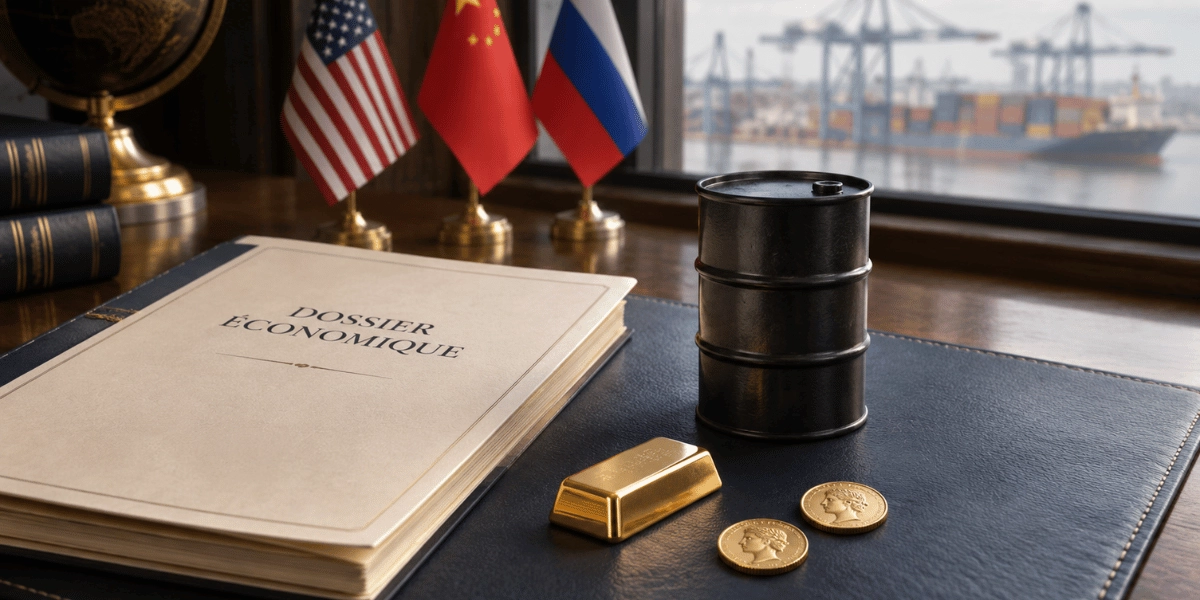
Diplomacy can quickly shift market trends, but it does not automatically determine the direction of the gold price. A meeting between major powers can reassure investors and reduce their safe-haven purchases. It can also influence oil prices, inflation outlooks, and interest rates—with consequences for gold that are sometimes contradictory.
Donald Trump, Xi Jinping, and Vladimir Putin are scheduled to meet on Thursday, November 19, in Shenzhen, on the sidelines of the 2026 APEC summit. APEC (Asia-Pacific Economic Cooperation) brings together 21 economies in the region to promote trade and economic cooperation. Nuclear energy and Iran are among the topics on the agenda. For the markets, the challenge will be to distinguish between signs of a thaw and commitments capable of bringing about a lasting change in risks.
What scenarios does this Trump-Xi-Putin summit open up for gold? Could a thaw in tensions weigh on its role as a safe-haven asset, or could it indirectly benefit gold through lower energy prices and interest rates? Conversely, would a hardening of tensions necessarily drive up the price of gold? The answer will also depend on the dollar and, for French investors, on the conversion to euros.
Key Takeaways from the Article
- Donald Trump, Xi Jinping, and Vladimir Putin are set to meet on Thursday, November 19, 2026, on the sidelines of the APEC summit in Shenzhen. Nuclear power and Iran are among the topics on the agenda.
- A credible easing of tensions could reduce demand for gold as a safe-haven asset. However, if it also drives down energy prices and expected interest rates, its impact on gold would be more nuanced.
- An escalation of tensions could fuel safe-haven buying, while simultaneously strengthening the dollar or fueling inflation fears—two potential headwinds for gold.
- The absence of an agreement would not necessarily constitute a failure. Markets will react primarily to the gap between the announcements and their expectations.
- For French investors, the price in euros, the premium on physical products, and the buyback terms remain key factors.
Shenzhen: A Scheduled Meeting, Not a Guaranteed Agreement
The APEC Leaders’ Summit is scheduled for November 18 and 19. The trilateral meeting will take place on the sidelines of this economic gathering. A distinction must be made between Sino-U.S. trade talks and the trilateral discussions on strategic issues.
The available announcements do not suggest a comprehensive resolution of the conflicts. U.S. officials have specifically indicated that the war in Ukraine would be addressed separately. Progress on nuclear talks would therefore not automatically mean a lifting of sanctions or a normalization of energy trade.
A credible de-escalation could reduce the demand for safe-haven assets
Scenario 1: Leaders announce specific commitments, a negotiation timeline, or monitoring mechanisms. If these measures reduce the risk of escalation, some investors might scale back their hedging positions. Gold could then see profit-taking.
However, gold’s status as a safe-haven asset would not disappear. Purchases are also driven by diversification and wealth preservation goals. The World Gold Council notes that geopolitics, monetary conditions, and investor behavior all contribute to the metal’s performance.
The effect will depend above all on the element of surprise: a widely anticipated easing of tensions could trigger less market movement than an unexpected and verifiable breakthrough.
Energy developments could change this initial assessment
An improvement in the outlook for Iran could ease concerns about oil supplies and transportation.The EIA notes that geopolitical disruptions to oil flows can influence prices, even when the uncertainty centers on a potential disruption.
A sustained decline in energy prices could ease some inflationary pressures. If markets then anticipate a less restrictive monetary policy, bond yields could ease and support gold, despite reduced demand for safe-haven assets.
This mechanism remains conditional. A statement on nuclear power does not immediately increase available supply. Furthermore, the U.S. CPI rose another 0.4% in October on a month-over-month basis: the peak alone would not alleviate price pressures. We must also compare the decline in nominal yields to that of expected inflation: if the latter falls further, real rates may rise. Cheaper energy, therefore, is not enough to signal a favorable environment for gold.
A tightening cycle does not guarantee a rise in gold prices
Second scenario: negotiations lead to threats, a breakdown in dialogue, or new restrictions. An escalation of risk could spur gold buying. But this reaction could be countered by other markets.
The dollar may also benefit from the flight to safety. Its appreciation would then make gold, priced in dollars, more expensive for buyers using other currencies. If oil prices rise at the same time, fears of persistent inflation could reinforce expectations of high interest rates.
The Chicago Fed’s analysis highlights gold’s sensitivity to real interest rates—adjusted for expected inflation. A rise in these rates can penalize an asset that pays no interest. Geopolitical tension can therefore support demand for gold as a safe haven without being enough to drive up its price.
A limited outcome could leave the market virtually unchanged
Third scenario: leaders maintain dialogue but make no operational commitments. This outcome would not necessarily be a failure if investors were not expecting an immediate breakthrough.
We would then need to look at what is actually changing: Is a channel for discussion still open? Are technical meetings scheduled? Are the announced positions compatible? A joint photo op or a general press release does not allow us to conclude that risks have been sustainably reduced.
In the absence of a diplomatic surprise, U.S. economic data, interest rate expectations, and investment flows could quickly take center stage again.
The Dollar and the Euro Exchange Rate: The Essential Filter in France
The dollar’s reaction remains uncertain. A détente could reduce safe-haven buying, but it could also improve the U.S. economic outlook. It would therefore be an overreaction to systematically link diplomatic rapprochement with a decline in the currency.
A stronger dollar can cushion a decline in the price of gold for a French investor. Conversely, a rising euro can reduce a gain measured in dollars.
Before making a transaction involving physical gold, it is also important to compare the total price, the premium on the coin or bar, and the offered buyback price. The price movement per ounce alone is not sufficient to measure the true cost of a transaction.
Conclusion
The risk for gold will depend less on the outcome of the summit than on its concrete consequences. A de-escalation could reduce safe-haven buying while easing energy and monetary pressures; a hardening of stances could support gold as a safe haven but also strengthen the dollar and interest rates. Ahead of Shenzhen, the most useful approach is to monitor the announced commitments, oil prices, real yields, and the price of gold in euros all at once.
By La rédaction Godot & Fils
Passionate and expert in the field of buying and selling precious metals, we put our expertise at your service to offer you in-depth analyses of gold and silver financial news. Driven by the desire to provide you with clear, reliable and relevant information, we ensure that each piece of content is both precise and concise. Our aim is to help you better understand market trends so that you can make informed decisions about your investments. Through our articles, we offer practical advice, decoding of major economic events and technical analysis to maximise your investment opportunities. Whether you are a beginner or an experienced investor, our content is designed to help you succeed in your precious metals investments. Follow us so that you don't miss out on any market developments and benefit from an expert's view of gold, silver and the economic dynamics that shape their value.
Receive the latest news by subscribing to the newsletter


 Zodiac Series : Scorpio 1 Oz Silver


 Panda 8g Gold

 EpargnOr 1oz


