Price and quotation of 10 Guilders on 10/26/2026 in real time : 700.00 € (0 %)
Intrinsic value : 696.66 €
Premium : 5.00 %

| Price evolution | |
| Weight | 6.72 grams |
| Fineness Gold | 900 ‰ |
| Diameter | 22 mm |
| Country | Netherlands |
| Face value | 10 Florins |
| Striking | Of 1875 at 1933 |
| Draw | 3 719 857 |
| Metal | Gold |
| Slice | Fluted |
| YOU BUY | Net unit price |
|---|---|
| 731.50 € |
| YOU SELL | Price per unit |
|---|---|
| 675.00 € |
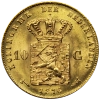
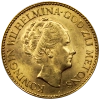
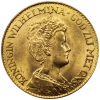
10 Florins gold coins come in a variety of effigies, such as those of Queen Wilhelmina or King Willem III. These are respectively engraved on the obverse of the 10 Florins gold coin.
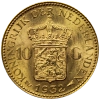
The reverse has the royal arms surrounded by the country's name KONINGRIJK DER NEDERLANDEN (Kingdom of The Netherlands) in Dutch with the date 1877 below the arms flanked by the broadaxe privy mark on the left and the caduceus mint mark for the Utrecht mint. The denomination 10 G flanks the arms.
A Dutch classic from the XIXᵉ-XXᵉ century, the 10 gulden (known as a "florin") takes up a clear standard: alloy 900‰ for a weight of around 6.72 g (≈ 6.05 g fine gold) and a diameter close to 22-22.5 mm. Standardized and widely distributed, this coin is immediately recognized by professionals and is easily exchanged in Europe. It can be found under several effigies - Wilhelm III then Wilhelmina, depending on the period - which facilitates access to common examples while remaining on a homogeneous gauge.
At the beginning of the XIXᵉ century, the creation of the Kingdom of the Netherlands (Congress of Vienna, 1815) was accompanied by a monetary reorganization. The 10 gulden gradually became the gold standard, taking over from the ducat in modern circulation. The first issues of the century illustrate the rise to power of the young monarchy: under William Iᵉʳ, the module was already minted (e.g. 1824), before becoming highly visible under William III from 1875. Industrialization and the boom in trade then stimulated minting in the kingdom's main workshops. At the juncture of the XIXᵉ and XXᵉ centuries, the format was revived under Wilhelmina: an initial series in the 1890s, followed by later vintages (notably 1911-1913 and 1917), testify to the enduring importance of this gold denomination in the Dutch economy.
The First World War upset the balance: as in the rest of Europe, the use of monetary gold declined, and issues eventually came to a halt. What remained were vintage stocks, the result of historic issues, and today sought-after for wealth savings thanks to their stable standard and international distribution.
Over twenty years, the trajectory mirrors that of the metal: strong growth between 2005 and 2011, a breathing space around 2013-2015, then a recovery from 2019 onwards, with peaks in 2020 and new records in 2024-2025 (gold in euros reached an all-time high in autumn 2024). For a long-term investor, this period illustrates a clear pattern: acceleration, consolidation, then new momentum, in line with the ounce.
It's standardized investment gold, derived from historic issues and available in several effigies (Wilhelm III, Wilhelmina), which broadens the offering while maintaining the same size. The format offers a good metal/price ratio: around 6.05 g of fine gold per coin, clear and easy to compare with the daily price. Stocks come from arrivals of period coins; supply being limited, this Dutch classic remains scarce in quantity compared to modern continuous minting.
Vintages and/or effigies of these coins are sent out randomly according to our stocks.
As these are bullion coins and not collector's items, their years of issue or effigies have no impact on their value or resale price.
Photos non contractual.
This is a standardized, liquid gold coin, generally minted after 1800, which is often exempt from VAT in France if it meets the purity and shape criteria defined by regulations.
You can buy or sell physical gold (coins or bars), which are considered exchangeable products. We invite you to consult our gold investment guide to help you define your investment strategy.
Simply send it to us by post. We'll send you a free Gold Kit, which explains how to return your investment gold coins to us. You can also fill in the "You're selling" box at the top right of this page, which will give you a real-time price estimate.
In France, two options are available:
- TMP (flat-rate capital gains tax): 11,50% of the sale price if no proof of sale is provided,
- TPV (taxe sur la plus-value): 37,60% applied to the actual capital gain, with an annual allowance of 5% from the 3rdᵉ year, and total exemption after 22 years of ownership.
The premium represents the extra cost above the value of pure gold, reflecting manufacturing and distribution costs and market demand. The rarer the condition or vintage, the higher the premium.
We offer two storage solutions for your precious metals: Gardien'Or and Coffre-Fort Privé.


OUR NEWSLETTER