Price and quotation of 20 Reichsmarks on 10/27/2026 in real time : 830.00 € (0 %)
Intrinsic value : 838.47 €
Premium : 4.89 %

| Price evolution | |
| Weight | 7.965 grams |
| Fineness Gold | 900 ‰ |
| Diameter | 22 mm |
| Country | Germany |
| Face value | 20 reichsmarks |
| Striking | Of 1871 at 1915 |
| Metal | Gold |
| YOU BUY | Net unit price |
|---|---|
| of 1 to 9 coins | 880.50 € |
| 10 Coins or more | 879.50 € |
| YOU SELL | Price per unit |
|---|---|
| 810.00 € |
Bare head of King Wilhelm II facing right. As well as the inscription: WILLHELM II DEUTSCHER KAISER KÖNIG V PREUSSEN
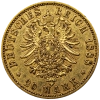
Crowned arms of Germany, a spread eagle. The inscription DEUTSCHES REICH, the date, and 20 MARK.
A classic of European savings, the German 20 Mark module (often referred to as "20 Reichsmarks" on merchant sites) imposes itself through a clear standard: 900 ‰ alloy, around 7.965 g for a diameter close to 22-22.5 mm. Minted on a large scale in the late XIXᵉ and early XXᵉ centuries, it circulates easily on the secondary market thanks to its international recognition. This format is sometimes presented as the alter ego across the Rhine of the French Napoleon, while offering more fine gold per coin (≈ 7.16 g).
The history of this 20 Reichsmark follows that of German unification. After 1871, the Empire (Deutsches Reich) organized a common coinage; the imperial workshops put into circulation a gold 20 Mark, which became the reference denomination for high-value payments and private reserves.
Prussia was a major issuer, with continuous minting under Wilhelm II, notably from 1890 to 1913 in Berlin and, for certain vintages, in Hamburg. Other states or free cities integrated into the Empire (e.g. Hamburg) also issued the same module, reinforcing the homogeneity of the system and its distribution throughout the German-speaking world.
Minting lasted from 1871 to 1915, then came to a halt with the outbreak of the First World War, when gold disappeared from circulation. The legal use of the 20 Mark would later come to an end: demonetization was set for August 16, 1938, marking the definitive exit of gold money from everyday life.
Today, these period issues-issued by several workshops and political entities of the Empire-are sought-after for the quality of their manufacture and the consistency of their standard, constituting a representative milestone of classic European gold.
Over a twenty-year period, the behavior of this module reflects above all that of the gold price. There was a sharp rise over the period 2005-2011, followed by a consolidation phase around 2013-2015, before a sustained recovery from 2019 onwards. In September 2024, gold in euros reached an all-time high; in 2025, market analyses still point to a long-term bullish bias.
This is historic investment gold, immediately identifiable, with standardized specifications (Au 900 ‰, ~ 7.16 g fine gold). Its format is the German alter ego of the Napoleon: same "classic" coin-type logic, widely distributed in Europe, but with a higher metal content per unit-a good metal/price ratio for those aiming for gold accumulation at the best unit cost. Stocks come from period issues; supply being finite, availability remains scarce in quantity compared to continuous modern minting. Finally, the quotation is naturally aligned with spot gold in euros, making it easier to track and resell.
Vintages and/or effigies of these coins are sent out randomly according to our stocks.
As these are bullion coins and not collector's items, their years of issue or effigies have no impact on their value or resale price.
This is a standardized, liquid gold coin, generally minted after 1800, which is often exempt from VAT in France if it meets the purity and shape criteria defined by regulations.
You can buy or sell physical gold (coins or bars), which are considered exchangeable products. We invite you to consult our gold investment guide to help you define your investment strategy.
Simply send it to us by post. We'll send you a free Gold Kit, which explains how to return your investment gold coins to us. You can also fill in the "You're selling" box at the top right of this page, which will give you a real-time price estimate.
In France, two options are available:
- TMP (flat-rate capital gains tax): 11,50% of the sale price if no proof of sale is provided,
- TPV (taxe sur la plus-value): 37,60% applied to the actual capital gain, with an annual allowance of 5% from the 3rdᵉ year, and total exemption after 22 years of ownership.
The premium represents the extra cost above the value of pure gold, reflecting manufacturing and distribution costs and market demand. The rarer the condition or vintage, the higher the premium.
We offer two storage solutions for your precious metals: Gardien'Or and Coffre-Fort Privé.


OUR NEWSLETTER