
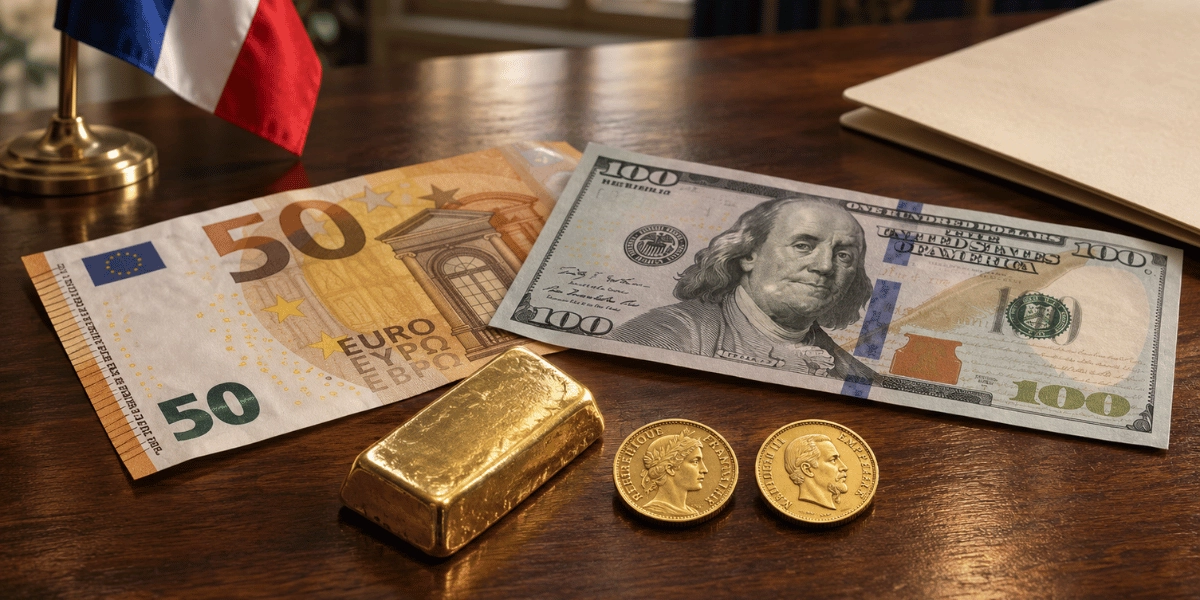
a French investor. When the euro also weakens, converting the metal into euros offsets part of the decline. This mechanism came into play during the week ending November 20, 2026, which was marked by one of gold’s sharpest corrections in several months.
A strong dollar and expectations of rising U.S. interest rates weighed on the metal. At the same time, the euro was trading near its lows for the year. This currency weakness provided some support for gold’s value expressed in euros, though to a limited extent.
Why are French investors partially protected, and how much of the decline is actually due to the metal itself versus exchange rates? To assess this, we compare the daily closing prices on November 13 and 20 from the same provider. This weekly analysis is separate from the market activity on Monday, November 23, when gold was already rebounding.
Key Takeaways from the Article
- Between the close of trading on November 13 and November 20, 2026, spot gold fell 8.96% in dollars in the selected data series.
- Over the same period, the euro fell from 1.1023 to 1.0968 per dollar. This decline reduced the calculated drop in gold prices in euros to 8.51%.
- The exchange rate offset approximately 0.46 percentage points of the decline. It reduced the loss without eliminating it: the movement in the price of gold remained the dominant factor.
- A theoretical portfolio of 10,000 euros in gold drops to approximately 9,149 euros, compared to 9,104 euros if the exchange rate had remained stable, excluding fees and taxes.
- The price of a gold bar or a Napoleon coin also depends on its premium and buyback terms. These calculations are not resale quotes.
Why a Weaker Euro Supports Gold Priced in Euros
The international price of gold is generally quoted in dollars. To determine its equivalent in France, you must take into account the EUR/USD exchange rate, which indicates how many dollars one euro is worth.
Gold price in euros = gold price in dollars ÷ EUR/USD exchange rate.
If one euro buys fewer dollars, more euros are needed to pay for the same amount of gold, assuming the price in dollars remains unchanged. This conversion supports the value in euros of the metal already held, even if the investor has never purchased dollars.
A decline of 8.96% in dollars, 8.51% in euros
Investing.com’s historical data shows the following closing prices. We calculate the euro equivalent by dividing the price per ounce in dollars by the EUR/USD exchange rate for each date:
| Closing Date | 11/13/2026 | 11/20/2026 | Change |
| Gold, dollars per ounce | $3,880.70 | $3,532.85 | -8.96% |
| EUR/USD, dollars per 1€ | 1.1023 | 1.0968 | -0.50% |
| Gold, in euros per ounce (calculated) | 3,520.55 € | €3,221.05 | -8.51% |
Sources: Investing.com daily XAU/USD and EUR/USD historical data; editorial calculations. Euro equivalents are recalculated and rounded. These end-of-day figures are used to estimate the weekly effect; they are not executable quotes at a specific point in time.
The decline in the price of gold in dollars is therefore the primary factor: −8.96%. The depreciation of the euro reduces the decline in euros to −8.51%. This offsetting effect accounts for approximately 0.46 percentage points, using the unrounded values.
A euro that is already weak is not enough to produce this effect: it must depreciate during the period under review. If it remains stable, the change in the price of gold is identical in both currencies.
Isolating the exchange rate: approximately 16 euros saved per ounce
To separate the two effects, let’s keep the final gold price but assume that the euro remained at 1.1023 dollars. The ounce would then be worth approximately 3,204.98 euros. With the final exchange rate of 1.0968 dollars, it is worth approximately 3,221.05 euros.
The difference—16.07 euros per ounce—stems from the exchange rate in this calculation. It does not represent an overall gain: the value of the ounce still fell by approximately 299.50 euros over the week.
Percentages are combined by multiplication. Therefore, we do not simply subtract the 0.50% decline in the euro from the 8.96% drop in gold. Comparing the figures using a constant exchange rate allows us to accurately quantify the loss in value.
An example for someone holding 10,000 euros worth of gold
Let’s consider a quantity of gold worth 10,000 euros on November 13, before premiums, fees, and taxes. Given the observed price movements, its theoretical value reached approximately 9,149 euros on November 20: the loss amounts to about 851 euros.
If the exchange rate had remained stable, the value would have fallen to about 9,104 euros. The decline in the euro therefore preserved nearly 46 euros in this example. The holder remains heavily exposed to the metal: the exchange rate offset only a small portion of the decline.
Bar and Napoleon Coin Prices: Factoring in Physical Conditions
The price of gold in France is not sufficient on its own to determine the resale price of a product. The price of a gold bar depends, in particular, on its fine gold weight, the premium, and the buyback offer. The price of a Napoleon coin also depends on the coin market and its condition.
A 20-franc Napoleon contains approximately 5.8064 grams of pure gold. Its metal value would undergo the same fluctuation in euros as the ounce, but its premium may vary differently. Therefore, one should not mechanically apply the −8.51% to a previous retail price to arrive at a current offer.
A useful comparison involves buyback prices for the same product, recorded on comparable dates, followed by the amount remaining after fees and any applicable taxes. Our calculations isolate the metal and the exchange rate; they do not measure a net return.
A hedge that can backfire
The mechanism works both ways. If the euro rises, it can exacerbate a decline in the price of gold in euros or mitigate a rise observed in dollars.
The situation is already changing: on Monday, November 23, at 12:42 p.m. GMT (1:42 p.m. in Paris), spot gold rebounded to $3,617.68 per ounce, up 2.4%, as the dollar took a breather. This figure is distinct from the closing prices used in our weekly calculation.
Conclusion
The weakness of the euro cushioned part of the decline in gold prices between November 13 and 20, but only by about 0.46 points according to our calculations. French investors therefore lost slightly less in euros than in dollars, though they were not entirely immune to the correction. To assess the value of their investment, they must monitor the price of gold, exchange rates, and the buyback price of their physical gold products collectively.
By La rédaction Godot & Fils
Passionate and expert in the field of buying and selling precious metals, we put our expertise at your service to offer you in-depth analyses of gold and silver financial news. Driven by the desire to provide you with clear, reliable and relevant information, we ensure that each piece of content is both precise and concise. Our aim is to help you better understand market trends so that you can make informed decisions about your investments. Through our articles, we offer practical advice, decoding of major economic events and technical analysis to maximise your investment opportunities. Whether you are a beginner or an experienced investor, our content is designed to help you succeed in your precious metals investments. Follow us so that you don't miss out on any market developments and benefit from an expert's view of gold, silver and the economic dynamics that shape their value.
Receive the latest news by subscribing to the newsletter


 50 Mexican Pesos



 10 French Francs


