
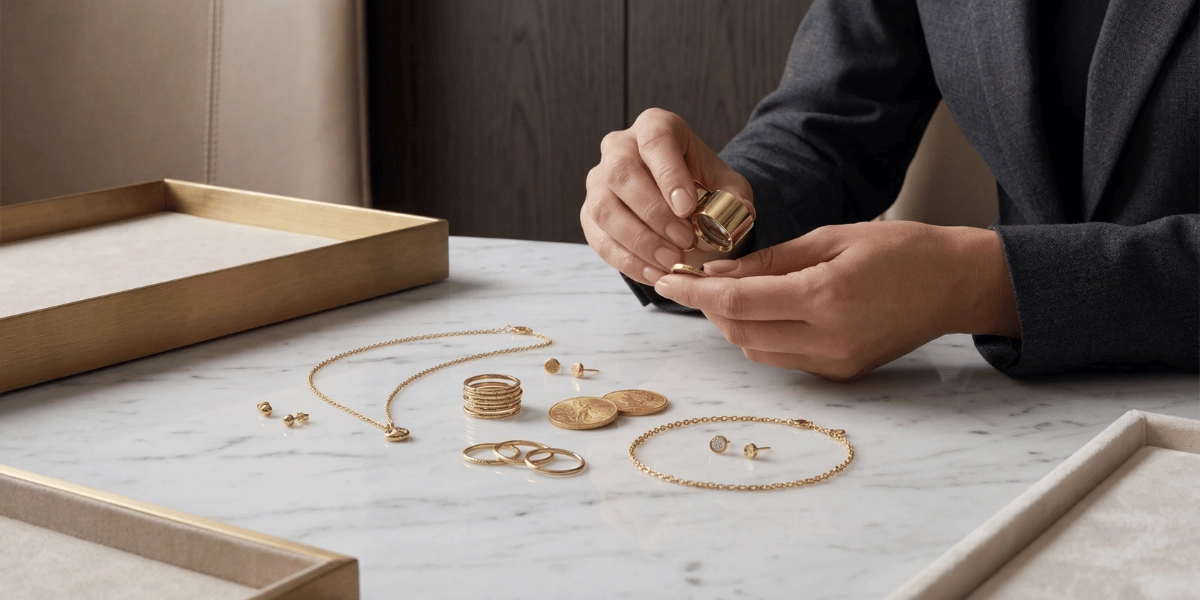
Selling a piece of jewelry, a coin, or a small batch of precious metal may seem straightforward at first. However, as soon as the subject turns to a gold buyback, one question almost always comes up: what exactly is the offered amount based on? Between the gold price quoted in the news, the sentimental value of the item, and the figure actually proposed by a professional buyer, the gap can be confusing.
In practice, the calculation relies on several precise factors. The international market price is a key benchmark, but it is not enough on its own. Purity, actual recoverable weight, the form of the item, verification procedures, and, in addition, the margin required by the professional who buys and then resells or refines the metal must also be considered. As a result, the same gram of gold does not always lead to the same final price in every situation.
Understanding these mechanisms helps avoid misleading comparisons and makes it easier to assess an offer properly. The real issue is therefore not only what gold is worth in theory, but how that reference price is turned into a concrete offer during a gold buyback. That is exactly what the following breakdown explains step by step.
The gold market price is the starting point, not the final offer
The first benchmark used in a gold buyback is the gold price on international markets. This rate, usually quoted per ounce, reflects the value of pure gold at a given moment. It moves according to supply, demand, the economic climate, monetary policy, and gold’s role as a safe-haven asset. Nevertheless, this figure remains a theoretical basis: it refers to pure traded metal, not directly to a worn bracelet, a broken chain, or an old ring.
To turn that reference rate into a concrete offer, the quote must first be converted into a unit that makes sense for a private seller, usually the gram. Next, the specific features of the item must be applied. Likewise, a price displayed in-store or mentioned over the phone only becomes meaningful when it is tied to a specific purity level and a clear weighing method. Without that detail, comparing buyers remains incomplete.
In other words, the gold price provides direction, but it does not summarize the whole valuation. As a result, a serious buyer does not simply mention the market rate of the day; they explain how that market value translates into the items being presented.
Why purity has a major effect on value
Before discussing the amount, the quality of the metal must be identified. A 24-karat item does not contain the same proportion of gold as 18-karat, 14-karat, or 9-karat jewelry. The higher the share of fine gold, the higher the calculation base. In practice, the professional relies on hallmarks when they are readable and, if needed, confirms them with suitable tests.
This stage is essential because the total weight of an object does not automatically equal the quantity of pure gold inside it. A 10-gram ring in 18 karats is not worth 10 grams of fine gold, but 75% of that mass in pure-metal equivalent. In addition, some items include solder, mixed alloys, or non-precious parts that justify further adjustments. That is why purity is one of the most important components of the calculation.
The accepted weight must be net and verifiable
Once purity has been identified, the second key factor is weight. Here again, this is not a minor detail. The professional must weigh the item accurately and, when necessary, separate the parts that actually contain gold from those that do not. In addition, stones, non-precious clasps, springs, or decorative parts may be excluded if they distort the valuation of recoverable metal.
This method protects both seller and buyer. It reduces the offer to a simple basis: a net weight, linked to a purity level, applied to a market price. In that way, the formula becomes easier to understand. Even when the process sounds technical, the goal is very practical: to determine how much real fine gold is present in the submitted item.
The formula combines metal value with the buyer’s margin
At this point, the reasoning can be summarized clearly: start with the day’s market price, convert it to grams, apply the item’s purity, and multiply by the accepted net weight. This produces a theoretical value for the metal content. However, that number does not automatically equal the amount paid to the customer. One more stage must be added, and it explains the difference between the metal’s raw value and the final offer.
Before looking at these adjustments in detail, it is worth remembering that a professional gold buyback operation includes several costs: testing the items, security, market fluctuations between purchase and resale, possible refining, administrative handling, and normal business overhead. Moreover, the business model differs depending on whether a piece of jewelry can be resold as is or whether the gold is intended for melting. The final offer therefore logically includes a margin.
This margin is not, by itself, a sign of opacity. It only becomes problematic if it cannot be understood or if no explanation is given to the seller. By contrast, a reliable offer is based on traceable elements, with clear information about the market price used, the purity observed, and the weight retained.
- Reference metal value on the day of appraisal
- Application of the item’s actual purity
- Calculation based on useful net weight
- Deduction of margin and processing costs
In short, the amount paid is neither arbitrary nor exactly equal to the stock-market price. It results from a step-by-step calculation followed by a commercial adjustment consistent with the realities of the trade.

What can make one buyer’s offer differ from another’s
Two professionals may examine the same item and produce different offers without that automatically meaning one calculation is wrong. Several variables come into play after the raw metal value has been estimated. Some buyers work with a tighter margin, while others build in more protection against market fluctuations. Likewise, the intended destination of the item matters a great deal: if it can be resold as jewelry, the logic is not exactly the same as for a lot meant to be melted down.
The practical conditions of the appraisal also matter. A transparent business sets out the weight, the purity used, the market rate applied, and the final amount offered. By contrast, an offer made too quickly, with no explanation, makes it impossible to check whether the calculation is consistent. In addition, timing plays a meaningful role, since the gold price can move from one day to the next.
To assess an offer properly, a few simple habits are helpful:
- ask which reference market price is being used;
- check the karat or purity level retained;
- make sure the stated weight is the useful net weight;
- compare offers made on the same day;
- choose a professional able to explain the calculation clearly.
Returning to the starting point, it becomes clear that the price in a gold buyback never comes from a single figure posted on a sign. It results from a logical sequence: a market rate, a purity check, a net weighing process, and a margin applied methodically. Therefore, the right question is not only “how much is my gold worth?” but also “how was this amount built?”. When that construction is transparent, the offer becomes easier to understand, easier to compare, and far more reassuring for the seller.
By La rédaction Godot & Fils
Passionate and expert in the field of buying and selling precious metals, we put our expertise at your service to offer you in-depth analyses of gold and silver financial news. Driven by the desire to provide you with clear, reliable and relevant information, we ensure that each piece of content is both precise and concise. Our aim is to help you better understand market trends so that you can make informed decisions about your investments. Through our articles, we offer practical advice, decoding of major economic events and technical analysis to maximise your investment opportunities. Whether you are a beginner or an experienced investor, our content is designed to help you succeed in your precious metals investments. Follow us so that you don't miss out on any market developments and benefit from an expert's view of gold, silver and the economic dynamics that shape their value.
Receive the latest news by subscribing to the newsletter


 Walking Liberty 1 once Silver
 Zodiac Series : Aquarius 1 Oz Silver


