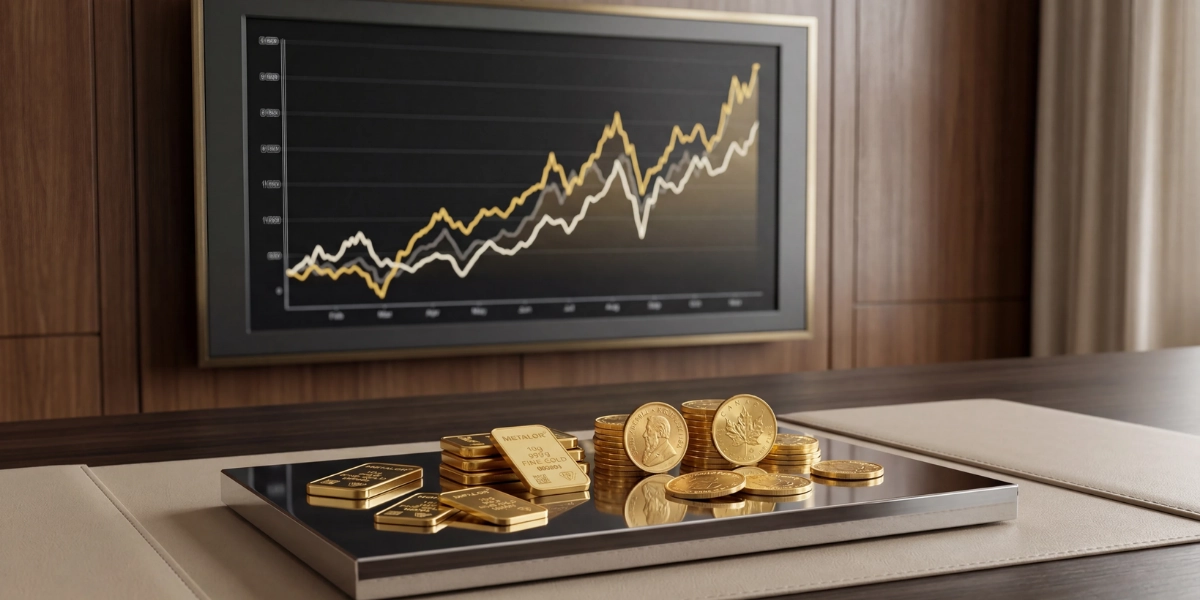
In an environment marked by the return of rising prices and economic uncertainties, capital preservation is once again a central issue for investors. Indeed, since the mid-2000s, markets have been punctuated by contrasting cycles, between expansive monetary policies, financial crises, rising interest rates and geopolitical tensions, redefining the role of safe-haven assets. In this sense, gold has established itself as a benchmark, a time-honored safe-haven asset.
So, to what extent is gold an effective protection against inflation over the long term?
An analysis of the 2005-2026 period provides a framework for linking the major macroeconomic dynamics - inflation cycles, real interest rate trends, etc. - to the current situation.real interest rates, monetary policy trends and the geopolitical context, to their effects on gold markets. This approach will also enable us to grasp the concrete implications for investment, notably through the use of gold in its various formats, which are among the most widespread on the market. All this forms part of a structured,long-term approach to asset diversification.
Market volatility and gold's resilience
Between 2005 and 2026, the global economy underwent successive phases of expansion, contraction and monetary normalization, marked in particular by the 2008 financial crisis, prolonged low-rate policies and more recent monetary tightening cycles. These developments have generated periods of great uncertainty on financial markets, accompanied by heightened volatility in risky assets.
Against this backdrop, gold has gradually consolidated its status as a benchmark asset during periods of market fluctuation. Its function, often uncorrelated with equity and bond markets during phases of tension, illustrates its ability to preserve its value when macroeconomic conditions deteriorate or investor expectations worsen. This characteristic explains the growing interest in gold in financial diversification strategies .
In practical terms, these dynamics translate into a sustained demand for the yellow metal, notably through the acquisition of bullion and well-known bullion coins. These formats offer direct exposure to the precious metal and are part of a long-term holding logic, in response to economic uncertainties and financial market fluctuations.
Inflationary pressures and changes in the monetary system
Over the same period, inflationary dynamics have alternated between contained phases and episodes of sharper price rises, under the combined effect of accommodating monetary policies, supply shocks, geopolitical tensions and structural imbalances in the global economy.
Developments in the general price level have also revived concerns about the preservation of purchasing power and the erosion of the value of fiat currencies.
At the same time, the international monetary system has undergone gradual adjustments, notably through the fructification of reserves by certain central banks and the evolution of financial flows on a global scale. These trends are contributing to a recomposition of monetary balances, in an environment where economic players are seeking to reduce their exposure to certain dominant currencies.
In this context, gold retains a structuring role as a store of value in the face of inflationary and monetary uncertainties. Investing in gold, via coins or bullion, is therefore a tool for securing assets, combining protection against inflation with asset diversification in a changing economic context.

Gold: a strategic asset pillar
Gold occupies a special place in asset allocation strategies, thanks to its ability to provide effective returns compared to traditional financial assets. Its value, influenced by macroeconomic factors such as real interest rates, inflation and market expectations, is characterized by a certain decorrelation during fluctuating phases, which helps to improve the overall risk/return profile of a portfolio over the long term.
As such, in a structured asset management approach, it is not just a defensive asset, but also one that can play a part in a logic of progressive value enhancement, in line with economic cycles.
Moreover, the integration of gold into an investment strategy also relies on the choice of standardized and recognized supports, which facilitate liquidity and position management. References such as the Britannia 1 ounce gold or the 10 Florins gold could constitute formats appreciated for their accessibility and ease of resale.
On the other hand, ingots such as the one-ounce gold bullion represent a homogeneous medium, enabling direct exposure to the metal with a simple structure suited to the gradual build-up of a long-term financial investment.
From this point of view, the yellow metal is a coherent, long-term diversification tool, designed to balance a portfolio, make it more resilient in the face of economic hazards, and support an asset enhancement strategy built up over time.
Ultimately, the 2005-2026 period highlights gold's singular role in an economic environment marked by inflation cycles, evolving monetary policies and successive phases of market uncertainty. Although not perfectly correlated with inflation in the short term, the yellow metal has nevertheless demonstrated its ability to appreciate over the long term. to appreciate over the long term against a backdrop of loss of purchasing power, low or negative real interest rates and geopolitical tensions.
Furthermore, the yellow metal has established itself as a benchmark asset, whose performance is part of a dynamic influenced by global macroeconomic factors rather than a single variable. Its behaviour, alternating between phases of acceleration and periods of consolidation, reflects its integration into the arbitrages of investors in search of protection and fructification.
As a result, gold continues to play a key role in wealth allocation, providing a complementary dimension to traditional assets. Its interest lies as much in its function as a store of value as in its ability to contribute to the overall balance of a portfolio, thus confirming its enduring role in the face of challenges linked to inflation or contemporary economic transformations.
By La rédaction Godot & Fils
Passionate and expert in the field of buying and selling precious metals, we put our expertise at your service to offer you in-depth analyses of gold and silver financial news. Driven by the desire to provide you with clear, reliable and relevant information, we ensure that each piece of content is both precise and concise. Our aim is to help you better understand market trends so that you can make informed decisions about your investments. Through our articles, we offer practical advice, decoding of major economic events and technical analysis to maximise your investment opportunities. Whether you are a beginner or an experienced investor, our content is designed to help you succeed in your precious metals investments. Follow us so that you don't miss out on any market developments and benefit from an expert's view of gold, silver and the economic dynamics that shape their value.
Receive the latest news by subscribing to the newsletter


 20 Swiss Francs

 Britannia 1/2 Once Gold