Price and quotation of Double Eagle on 10/26/2026 in real time : 3 749.75 € (0 %)
Intrinsic value : 3 466.39 €
Premium : 4.94 %

| Price evolution | |
| Weight | 33.437 grams |
| Fineness Gold | 900 ‰ |
| Diameter | 34 mm |
| Country | United States |
| Face value | 20 Dollars (USD) |
| Striking | Of 1849 at 1933 |
| Draw | 175 000 000 |
| Metal | Gold |
| Slice | Striated |
| YOU BUY | Net unit price |
|---|---|
| of 1 to 9 coins | 3 674.50 € |
| of 10 to 49 coins | 3 667.00 € |
| of 50 to 99 coins | 3 652.00 € |
| 100 Coins or more | 3 637.50 € |
| YOU SELL | Price per unit |
|---|---|
| 3 400.00 € |
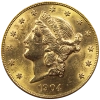
The obverse (front) depicts Liberty holding a staff and olive branch as she walks from the sun. The date appears to the viewer's right of Liberty (the date appeared in Roman numerals "MCMVII" on a portion of the coins minted in 1907). The word 'LIBERTY' arcs above her. Stars representing the number of states in the union (46 from 1907-11 and 48 from 1912-33) curve around the rim. This depiction of Liberty was so acclaimed the Mint chose to use this same design when it created the modern American Eagle coins.
The reverse (back) of the $20 St. Gaudens gold coin features a bald eagle gliding across the sun. The words "UNITED STATES OF AMERICA" and "TWENTY DOLLARS" span across the top of the coin. Although it was initially omitted from coins minted in 1907 and the first half of 1908, the motto "IN GOD WE TRUST" lies underneath the eagle.
An icon of American thrift, the .900-standard "Double Eagle" was minted from 1849 to 1933 to accompany the economic boom in the United States. Its generous size (~33.43 g for ~34 mm) and massive distribution make it an international benchmark, easily identifiable by professionals. On the French market, it is one of the most sought-after foreign coins, thanks to its homogeneous characteristics, clear price references and depth of stock, making it easy to buy and resell.
The coin was put into circulation in the heart of the XIXᵉ century, during the gold rush: the influx of Californian metal from 1848 onwards prompted the Administration to create a high denomination to fluidify payments of large amounts and secure bank reserves. As early as 1849, the $20 face value became the norm, with a 900 ‰ alloy and a standard weight set at 516 grains (≈ 33.436 g). Minting quickly relied on a network of workshops - notably San Francisco - to absorb metal flows and supply the economy with new coins.
At the end of the XIXᵉ century and the beginning of the XXᵉ, production becomes truly industrial: over 84 years, the United States issued more than 175 million pieces (equivalent to around $3.5 billion in face value), and the coin circulated beyond American borders, including Central America and British Honduras.
The First World War and the 1930s disrupted the gold standard and the daily use of coins; 1933 saw the cessation of issues and the gradual withdrawal of gold from circulation. What remained was a powerful legacy: a format that was both patrimonial and "exchangeable", whose uniformity has spanned the decades and continues to inspire the confidence of European savers.
Over twenty years, the trajectory mirrors that of the metal: sharp rise 2005-2011, consolidation 2013-2015, then a new upward cycle from 2019 onwards, with record highs in 2020 and new peaks in 2024-2025.
It's standardized investment gold: .900 alloy, stable weight/diameter, abundant market references. It can be traded worldwide by professionals, is highly prized on the American market and is available in several effigies and vintages, broadening the range without losing legibility. Its status as a historic coin, minted in very large numbers, ensures solid liquidity.
Vintages and/or effigies of these coins are sent out randomly according to our stocks.
As these are bullion coins and not collector's items, their years of issue or effigies have no impact on their value or resale price.
Photos non contractual.
This is a standardized, liquid gold coin, generally minted after 1800, which is often exempt from VAT in France if it meets the purity and shape criteria defined by regulations.
You can buy or sell physical gold (coins or bars), which are considered exchangeable products. We invite you to consult our gold investment guide to help you define your investment strategy.
Simply send it to us by post. We'll send you a free Gold Kit, which explains how to return your investment gold coins to us. You can also fill in the "You're selling" box at the top right of this page, which will give you a real-time price estimate.
In France, two options are available:
- TMP (flat-rate capital gains tax): 11,50% of the sale price if no proof of sale is provided,
- TPV (taxe sur la plus-value): 37,60% applied to the actual capital gain, with an annual allowance of 5% from the 3rdᵉ year, and total exemption after 22 years of ownership.
The premium represents the extra cost above the value of pure gold, reflecting manufacturing and distribution costs and market demand. The rarer the condition or vintage, the higher the premium.
We offer two storage solutions for your precious metals: Gardien'Or and Coffre-Fort Privé.


OUR NEWSLETTER