
 Antique
 Byzantine
 Gauloise Grecque
 Romaine



The Ancient Period: Foundations of Our Civilization
Antiquity spans approximately from 3000 BCE to the fall of the Western Roman Empire in 476 CE. It marks the beginnings of written history and sees the birth of the first great civilizations organized around cities, laws, and empires.
This era begins with the civilizations of Mesopotamia and Egypt. In Mesopotamia, between the Tigris and the Euphrates, the first forms of writing, the first city-states, and codified law, such as the Code of Hammurabi, appear. In Egypt, the pharaohs build a powerful civilization, marked by the pyramids, the Nile, and an advanced administrative system.
Further west, ancient Greece emerges around the 8th century BCE. The Greeks develop philosophy, democracy in Athens, the Olympic Games, and an art that still influences architecture, sculpture, and Western thought today. Greece is also a world of independent city-states (the poleis), often in conflict, but united by a common language and culture.
From the 3rd century BCE, Rome rises in power. Initially a small city in Latium, Rome becomes an empire that dominates the entire Mediterranean basin. Its military organization, roads, law, and language (Latin) have a lasting influence on Europe. The Roman Empire reaches its peak in the 2nd century CE, before experiencing crises, invasions, and ultimately its fall in 476.
The ancient period is also one of great exchanges. Trade routes connect Europe, Africa, and Asia. Ideas, goods, and currencies circulate. It is a time of conquests but also of cultural transmission.
Greek Coins: Art in the Service of Exchange
Ancient Greece was not the first to mint coins, but it was the first to give them a soul. From the 6th century BCE, cities like Athens, Corinth, or Aegina produce their own currencies. Each city-state mints its coins, asserting its identity and power.
Take an Athenian drachma. On the obverse: the head of Athena, goddess of wisdom and protector of the city. On the reverse: an owl, her symbolic animal, with large stylized eyes. Around it, the letters ΑΘΕ, abbreviation for “of the Athenians.” These coins circulate widely in the Mediterranean world, not only for their market value but for their quality of craftsmanship. They become a reference currency, essential for trade. They are beautiful, precise, struck in pure silver. They inspire confidence. And this, at a time when trust is essential for commerce.
Greek coins are not just for buying wine or amphorae. They are small works of art, where each face, each animal, each symbol (figures or references to the history of their city, deities, animals…) has meaning. Zeus, Poseidon, Heracles… the gods are everywhere, often depicted in a powerful or benevolent posture.
But the Greeks are not alone in forging their identity in metal. To the west, other peoples observe, learn, and create in turn.
Gallic Coins: Independence Through Metal
Before Rome extended its empire, the Gauls lived in tribes, each with its chiefs, customs… and sometimes its currencies. The first Gallic coins appear around the 3rd century BCE, inspired by Greek coins. Particularly those of Philip II of Macedon (the father of Alexander the Great), whose faces are copied, then transformed.
The Gauls take these Greek images and gradually transform them in their own way. A Greek face becomes a head with spiral hair. The horse deforms, becomes almost fantastical. The motifs become more abstract, more stylized. It’s no longer just about imitation but reinterpretation, creating a unique style.
Gallic coins are often in electrum (an alloy of gold and silver) or bronze. Some bear the names of chiefs, like Dumnorix or Vercingetorix. They are signs of authority, of power. They mark a territory, an era, an ambition.
Roman Coins: The Empire in Miniature
Rome doesn’t just conquer lands. It also imposes its currency. From the 3rd century BCE, the Romans mint coins to unify their economy. And they make it a major political tool.
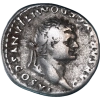
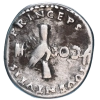
The Roman coin tells the story of Rome, emperor after emperor, from the Republic to the end of the Empire. On the obverse: the face of the ruler, from Julius Caesar to Augustus, from Nero to Constantine. On the reverse: military victories, temples, clear messages. An inscription might say: “FEL TEMP REPARATIO” — “the happy times are back.”
Take a silver coin, a denarius from Caesar’s time. It shows his profile, crowned with laurels. It’s the first time a living man allows himself to appear on a coin — a strong gesture, almost a challenge to republican traditions.
The Romans understand that currency circulates faster than armies. A coin can go from a market in Gaul to the Syrian desert. It carries the image of the emperor, it reminds of Rome’s power. Even conquered peoples see his face every day.
Roman coins are also practical. They exist in gold (aureus), silver (denarius), bronze (sestertius, as…). Each metal has its function, its use. And the amount of pure metal is controlled — at least at the beginning. Because over time, the empire expands, military expenses explode, and the coins lose their value. Less silver, more copper. Inflation is already starting.


