
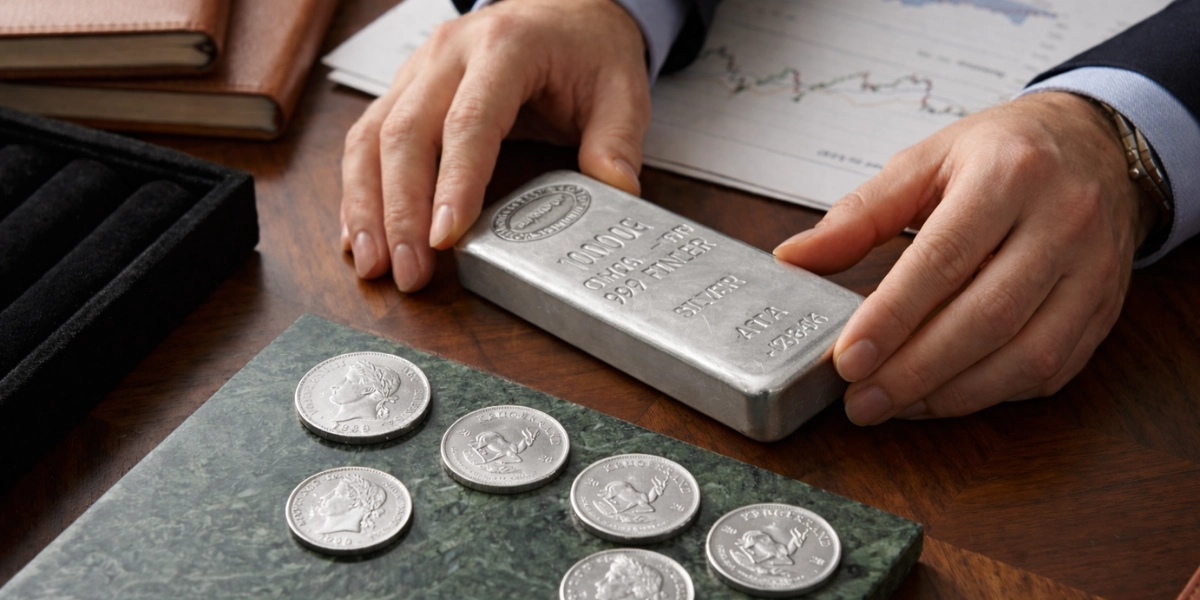
For several years now, the global macro-economy has been evolving in a profoundly unstable environment. Sustained inflation, exploding public debt, unconventional monetary policies and geopolitical fragmentation are redrawing the international financial balance.
Against this backdrop, attention is often focused on gold, the historic safe-haven par excellence. Yet recent events have also shown us that silver occupies an important place, at the crossroads between monetary asset and strategic commodity.
So, how does silver fit into the current global macro-economy, and what prospects can we reasonably envisage for the period 2026-2030 in the face of economic challenges?
To answer this question, we need to analyze silver's singular role in economic cycles, its link with monetary policies, its growing role in the real economy and its place in a wealth management approach.
Inflation and debt: a favorable environment for money
Inflation is no longer a transitory phenomenon. Despite monetary tightening by major central banks, price rises remain structural in many developed economies.
International institutions such as the International Monetary Fund (IMF) point out that inflationary pressures linked to energy, raw materials and supply chains are likely to persist beyond 2025.
Money and currency erosion
During periods of prolonged inflation, money tends to preserve purchasing power, even if it is more volatile.
This characteristic makes it an asset that is often underestimated, but particularly relevant when money is gradually losing its real value.
Global debt: a lasting imbalance
Global public debt is currently at unprecedented levels. According to data consolidated by the World Bank, the global debt-to-GDP ratio far exceeds the levels observed prior to the 2008 financial crisis. This massive accumulation of debt severely limits governments' room for manoeuvre.
What's more, in an over-indebted world, the temptation to let inflation reduce the real value of debt is strong. This implicit method weakens currencies and strengthens the appeal of tangible assets, of which money is one.
As investors become more aware of this dynamic, silver ceases to be perceived solely as a cyclical commodity and once again becomes a tool for monetary protection.

An asset with a dual monetary and industrial dimension
Unlike gold, whose demand is mainly financial, silver also benefits from structural industrial demand. When inflation accompanies real growth, demand for silver rises, boosting its valuation potential.
This characteristic makes silver a particularly reactive asset to economic fluctuations. Its price can move rapidly when inflation expectations or financial uncertainties rise, offering investors the opportunity to secure their capital while benefiting from phases of revaluation.
Unlike gold, which tends to serve primarily as a store of value, silver combines this protective function with a more dynamic performance potential, linked to market sensitivity to economic confidence and currency movements. This dual nature makes silver not only a provident tool, but also a strategic lever for adjusting a portfolio according to financial cycles, favoring both stability and opportunity.
Furthermore, silver is indispensable in a number of key sectors:
- energy transition (photovoltaic panels),
- electronics and semiconductors,
- electric vehicles,
- medical technologies.
According to several industry reports relayed by theInternational Energy Agency, the global energy transition is likely to lead to a structural increase in silver demand by 2030.
Monetary policies and silver price behavior
Central banks play a decisive role in the evolution of silver prices. Their monetary policy choices, constrained by the need to contain inflation while supporting growth, strongly influence investor perception and demand for this precious metal as a safe-haven asset.
Central banks under pressure
Central banks face a delicate balancing act: containing inflation without curbing growth or triggering a public debt crisis. This situation limits their room for manoeuvre and tends to keep real interest rates persistently low, or even negative.
In this context, money, like other tangible assets, benefits indirectly from this constrained monetary policy. Investors, anticipating the Central Banks' inability to raise rates significantly, are seeking to protect their assets against the loss of purchasing power, thus reinforcing the attractiveness of precious metals.
Silver and real rates
When real (i.e. inflation-adjusted) interest rates are negative, non-income-generating assets such as silver become more attractive. Unlike bonds or savings accounts, which lose value in real terms, money retains its purchasing power and can even rise in times of economic tension.
This dynamic is not new: it was already observed in the 1970s, marked by high inflation, or in the early 2000s, when low real interest rates stimulated demand for precious metals. Understanding this mechanism makes it possible to anticipate market movements and position silver as a defensive asset in a portfolio.
A more volatile, but more reactive metal
Silver is more volatile than gold: its fluctuations can be faster and more pronounced, sometimes lagging behind the movements of other precious metals. This characteristic may be perceived as a short-term risk, but it also offers strategic leverage for attentive investors.
What's more, over the long term, this reactivity amplifies valuation potential in a favorable context, while enabling us to take advantage of phases of market correction or tension. Knowing how to manage this volatility is therefore essential for effectively integrating silver into a balanced financial approach.
Outlook 2026-2030 and wealth integration
Money remains a key instrument for protecting and diversifying wealth, particularly in an economic climate marked by uncertainty and geopolitical tensions. Its role goes beyond mere speculation: it constitutes insurance against currency fluctuations and a lever of stability for savings. Depending on market trends, there are several possible trajectories for this precious asset.
Market scenarios: between inflation and economic fluctuations
In a scenario of controlled but lasting inflation, silver retains its role as a safe-haven asset. Even if price rises slow down compared with recent years, they would still exceed the historical targets set by the Central Banks, reinforcing investor interest in tangible assets.
Conversely, in the event of a major crisis, be it a financial shock, sovereign default or widespread geopolitical conflict, silver could rapidly revalue. In these tense times, investors seek to secure their capital in tangible, proven assets, and silver enjoys increased demand, both as protection and as a long-term financial investment.
Investing in silver: a sustainable wealth strategy
Investing in silver complements gold ownership while providing essential diversification.
Indeed, acquiring this precious metal can provide protection against inflation and economic fluctuations, while remaining accessible to investors wishing to position themselves in a tangible asset without aiming for immediate speculation.
The aim is to strengthen the resilience of your assets in the face of uncertainties, by combining security with medium- to long-term value enhancement potential. In this approach, money becomes a tool of stability and foresight, capable of weathering economic cycles while consolidating savings.
In conclusion, silver today stands at a unique macro-economic crossroads. Persistent inflation, excessive global debt and profound industrial transformation are creating a particularly favorable environment for this metal, which is often relegated to the background.
Looking ahead to 2026-2030, silver therefore appears to be an essential asset, both monetary and industrial, capable of responding to the structural imbalances of the global economy.
Its short-term volatility should not overshadow its long-term potential, as part of a well-considered approach to wealth management. Silver remains a precious ally in the face of economic and geopolitical uncertainties, confirming its strategic role in building and protecting wealth.
By Sébastien Gatel
Graduated in law and market finance, Sébastien has worked in financial institutions and wealth management for many years. At the same time, he contributes to various media outlets aimed at professionals and individuals, deciphering financial news and simplifying topics related to savings and investments.
Receive the latest news by subscribing to the newsletter




 4 Ducats
 250g Silver bar VAT Included
 20 Francs Napoleon


