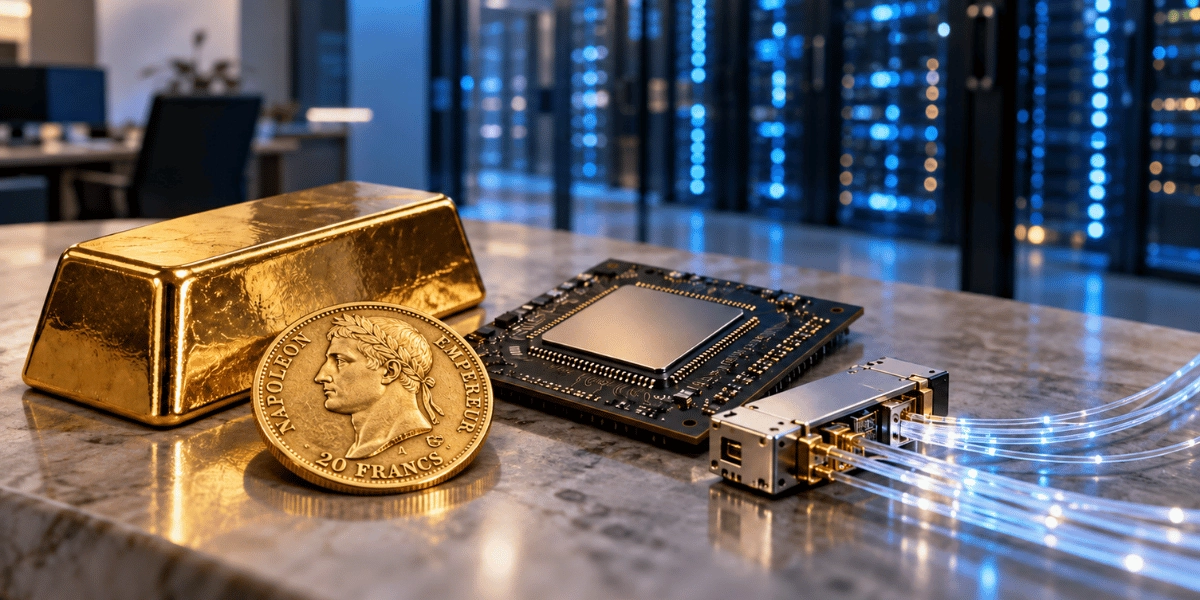
Artificial intelligence is often associated with copper, electricity, semiconductors, and silver. Gold is mentioned far less often. Yet it remains present in certain critical components of digital infrastructure. It is not used to build the AI models themselves. Rather, it is found in the hardware that enables chips to operate quickly, for long periods, and with a very high degree of reliability.
The topic has returned to the forefront with a study published in late September 2026 by the World Gold Council. Its message is nuanced: the AI boom has not yet dramatically transformed industrial demand for gold. Manufacturers are even seeking to reduce the amount of gold used when prices are high. But the study also identifies an area to watch: photonics, and more specifically, co-packaged optics, which could strengthen gold’s role in next-generation data centers.
Key Takeaways from the Article
· Gold isn’t the most visible metal in AI, but it’s still used in high-reliability electronic components.
· The World Gold Council notes that the boom in AI chips has not yet led to a massive increase in technological demand for gold.
· Industrial demand for gold related to AI is primarily driven by interconnects, certain power modules, photonics, and advanced optical architectures.
· Co-packaged optics could become a more significant market if data centers shift toward optical communications that are closer to the processors.
· For individual investors, this trend should be viewed as a long-term driver, not as an immediate catalyst comparable to central banks or ETFs.
Where does gold come into play in AI chips?
Gold is valued in electronics for simple reasons: it conducts electricity very well, resists corrosion, and remains reliable in demanding environments. In high-end components, these qualities matter more than the unit cost of the metal. This is particularly true when the failure of a component can cost far more than the savings realized on a few milligrams of gold.
In AI chips, gold may be found in connection wires, certain contacts, coatings, or specific interconnections. Its use is not universal. It can be replaced by copper, aluminum, or other materials when design constraints allow. However, in architectures where reliability, heat dissipation, or electrical stability are priorities, gold retains its place.
The World Gold Council notes that electronic applications remain the primary category of technological demand for gold. In its second-quarter 2026 report, the organization noted that the technological use of gold had strengthened slightly to 80 metric tons, driven in particular by demand related to AI, despite weakness in certain segments of the consumer electronics market.
Power Modules: The Unsung Hero of Data Centers
An AI data center is more than just GPUs. Thousands of chips must be powered, protected, cooled, and connected. This infrastructure relies on power modules, converters, connectors, high-frequency circuits, and components capable of withstanding high electrical loads.
This is where gold can play an indirect role. The World Gold Council already noted in its first-quarter 2026 technology analysis that the expansion of advanced power modules in the automotive sector and AI data centers continued to support certain uses of the metal. This is an important point: gold isn’t just in the chip. It can also be found around the chip, in the interconnect layers and components that ensure electrical continuity.
Industrial demand for gold therefore depends less on the number of servers than on the complexity of the architectures. The more power data centers seek per rack, the greater the demands for reliability and thermal management. This can sustain demand for high-end materials, even if manufacturers reduce the quantities used per component.
Photonics: Why AI Is Changing the Game
The real change may come from photonics. Large AI models require massive data exchanges between processors, memory, and network equipment. As clusters grow, the flow of information becomes a bottleneck. Moving data consumes energy, generates heat, and limits overall performance.
That’s why industry players are increasingly turning their attention to optical communications. The LightNOW website, citing an analysis by the Yole Group, explains that AI infrastructure is entering a phase where communication is becoming a key constraint for data centers. Optical interconnects and photonics are no longer just topics in telecommunications. They are becoming potential solutions to the bandwidth and energy efficiency challenges facing AI clusters.
In this context, gold can be used in certain optical or photonic components, particularly due to its durability and electrical performance. The World Gold Council also cites high-frequency electrodes and certain optical components as areas where gold remains relevant.
Co-packaged optics: a trend to watch
Co-packaged optics involves bringing optical components closer to processors or switching circuits. The goal is to reduce electrical losses, improve bandwidth, and limit energy consumption. For AI data centers, this topic is becoming strategic. Tom’s Hardware, in particular, has reported on NVIDIA’s ambitions regarding silicon photonics and co-packaged optics for next-generation AI infrastructure.
The World Gold Council specifically highlights co-packaged optics as an emerging field likely to support future demand for gold. It is not yet a tidal wave. The technology remains in the early stages of adoption, with trade-offs between cost, performance, reliability, and industrialization. But if data centers migrate to more integrated optical architectures, certain highly reliable materials—including gold—could benefit from this transition.
What Is Measurable, and What Remains Speculative
We must remain cautious. The World Gold Council’s study emphasizes one point: despite strong growth in demand for AI chips, demand for gold has not increased proportionally. Efforts toward miniaturization, substitution, and reducing the quantities used offset part of the growth in volume.
In other words, artificial intelligence does not automatically trigger an explosion in industrial demand for gold. Rather, it creates new, high-value-added applications. The potential exists, but it will depend on the speed of photonics adoption, the level of reliability required by hyperscalers, and the relative price of materials.
For the individual investor, this is a crucial distinction. Gold remains, first and foremost, a monetary and wealth-preserving asset. Central banks, ETFs, and physical demand currently have a much greater impact on the market than data centers. But industrial demand for gold linked to AI could become a secondary, discreet, and structural source of support.
Conclusion
Artificial intelligence also consumes gold, but in a less dramatic way than some market narratives suggest. The yellow metal remains present in high-reliability chips, power modules, interconnects, certain photonic components, and co-packaged optics architectures.
The key point is the nature of the demand. AI has not yet transformed gold into a mass-market industrial metal. Rather, it reinforces specialized applications where reliability takes precedence over cost. This alone is not enough to explain the price of gold. But it adds an interesting piece to the long-term thesis: gold is not just a safe-haven asset. It also remains a critical material in certain advanced technologies.
By La rédaction Godot & Fils
Passionate and expert in the field of buying and selling precious metals, we put our expertise at your service to offer you in-depth analyses of gold and silver financial news. Driven by the desire to provide you with clear, reliable and relevant information, we ensure that each piece of content is both precise and concise. Our aim is to help you better understand market trends so that you can make informed decisions about your investments. Through our articles, we offer practical advice, decoding of major economic events and technical analysis to maximise your investment opportunities. Whether you are a beginner or an experienced investor, our content is designed to help you succeed in your precious metals investments. Follow us so that you don't miss out on any market developments and benefit from an expert's view of gold, silver and the economic dynamics that shape their value.
Receive the latest news by subscribing to the newsletter

 Zodiac Series : Virgo 1 Oz Silver


 Britannia 1/4 Once Gold