
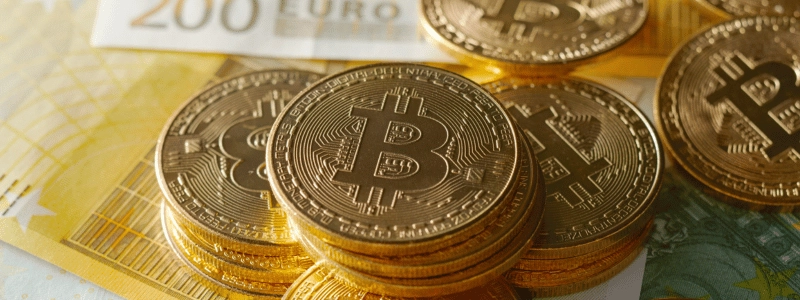
Last weekend saw a historic crash in the cryptocurrency market. In the space of 24 hours, over $19 billion in positions were liquidated, an absolute record in the history of the sector. In all, 1.6 million trader/investor accounts were liquidated, including 16.7 billion long positions, a sign of widespread panic fueled by leverage.
This event, which had not occurred on such a scale since 2017, reminds us just how unstable and still "immature" the cryptocurrency universe remains.
At the same time, this brutal episode revives an old debate: the trust placed in physical currency in the face of digital volatility.
Indeed, in the collectors' sphere, one question stands out: what impact do crypto-currencies have on numismatics, that ancient art of collecting traditional coins?
Between their fascination with digital modernity and their attachment to the tangible value of metal, collectors are navigating a world where history and technology now clash and sometimes even merge.
ARTICLE SUMMARY :
- 1) Two opposing monetary universes
- 2) Numismatics, a safe haven in an unstable digital world
- 3) Crypto-currencies: a threat or a source of inspiration
- 4) Towards the emergence of "crypto-numismatics
- 5) The effects of digital technology on the coin market
- 6) A changing collector profile
1) Two opposing monetary universes
Crypto-currencies and numismatics share an obvious point in common: both are interested in money. But beyond this apparent similarity, everything separates them.
Cryptos are based on blockchain technology:
- They are dematerialized,
- They are volatile,
- They are decentralized.
Traditional coins embody materiality and memory.
- They have a physical existence,
- They have weight,
- They have a patina,
- They have a history.
To understand the impact of crypto-currencies on numismatics, we must first recall what coin collecting is all about. Numismatics is not just a passion: it's also a heritage investment, based on rarity, conservation and the transmission of value.
In contrast, crypto-currencies offer a world of speed, instant transactions and anonymity. Where coins last for centuries, cryptos can lose much of their value in a matter of hours/days.
2) Numismatics, a safe haven in an unstable digital world
Every time the crypto market collapses, precious metals and physical currencies rally. Collectors see them as a tangible refuge, a counterweight to the virtual.
For example, gold and silver coins, issued by the Monnaie de Paris, continue to attract buyers. Their value lies both in the metal they contain and in their historical or artistic dimension.
Many investors today are adopting a mixed approach: a crypto portfolio for potential returns, and physical coins for stability. This behavior reflects a return to caution, especially after the repeated jolts of the digital market.

3) Cryptocurrencies: a threat or a source of inspiration?
Contrary to what some feared, crypto-currencies have not "killed" the passion for numismatics. On the contrary, they have sometimes rekindled it.
Many collectors have become interested in physical coins precisely because of cryptos. The need to hold a real object, with intrinsic value, has been reinforced by the dematerialization of wealth.
For their part, coin manufacturers have seized the opportunity: some monetary institutions, such as the Royal Mint or the Perth Mint, have launched commemorative coins dedicated to Bitcoin or Ethereum. These coins, although not cryptos, symbolize the meeting of two eras.
4) Towards the emergence of "crypto-numismatics
A new phenomenon is emerging: crypto-numismatics, i.e. a bridge between the digital world and traditional collecting.
Some players are experimenting with NFTs (non-fungible tokens) representing real coins. These digital certificates authenticate ownership of a physical object, paving the way for hybrid collecting.
- A collector can own a historic gold coin while holding its unique digital certificate.
- This dual existence (physical and blockchain) offers a guarantee of authenticity and traceability.
5) The effects of digital technology on the coin market
The world of collectors has not escaped digitalization. Cryptocurrencies have accelerated this process by introducing new tools and behaviors.
Exchange platforms now make it possible to buy or sell coins online, sometimes even in crypto.
Virtual auctions are multiplying, offering international exposure to rare coins.
Digital authentication, via blockchain, is developing to combat counterfeiting, an ancient scourge of numismatics (the traps of novice collectors).
These innovations are making the market more fluid, but also changing its nature. Some purists regret the disappearance of direct contact with coins; others see an opportunity to attract a new audience.
6) A changing collector profile
The rise of cryptos has also brought a new generation of technophile investors into the world of coins. These new buyers are looking not only for beauty or rarity, but also for financial performance.
Their logic is more speculative: they see the silver or gold coin as an arbitrage asset, likely to appreciate in value like a stock.
This has two consequences:
- An increase in volumes traded on certain modern references, deemed more liquid.
- Pressure on the prices of the best-known coins, such as Semeuse, Hercules or Maple Leaf, which are now also prized by investors, not just collectors.
But this approach can also blur the line between numismatic value and metal value, two notions often confused.
Conclusion
In the long term, cryptocurrencies and numismatics seem destined to coexist. One embodies the future of money, the other preserves its memory.
Successive crises in the crypto market, such as last weekend's, are a reminder that value rests above all on trust. And this trust is still embodied in metal, weight and symbol.
More generally, crypto-currencies have not weakened numismatics; they have transformed it. They have attracted a new audience, inspired innovations such as NFTs, and pushed collectors to modernize their practices.
But at heart, the traditional coin retains a major advantage: it is based on a tangible, verifiable value, steeped in history.
By Sébastien Gatel
Graduated in law and market finance, Sébastien has worked in financial institutions and wealth management for many years. At the same time, he contributes to various media outlets aimed at professionals and individuals, deciphering financial news and simplifying topics related to savings and investments.
Receive the latest news by subscribing to the newsletter


 50 Mexican Pesos

 1 oz Platinum Bar
 Zodiac Series : Virgo 1 Oz Silver


