
Gold exchange prices
on the 27/10/2026 to 11:07To find out the gold price, Godot & fils informs you of gold prices every day.
Gold bar and ingot prices
Updated on 10/26/2026 14:00
| Denomination | London prices | FR quotation | Variation | Premium | Graphic | You buy | You sell |
|---|
Gold coin prices
Updated on 10/26/2026 14:00
![1 Kilo Bar]() 1 Kilo Bar
1 Kilo Bar
 1 Kilo Bar
London prices
115 454.64 €
FR quotation
116 470.00 €
Variation
+0.71%
Premium
1.85 %
Graphic
![20 Francs Napoleon]() 20 Francs Napoleon
20 Francs Napoleon
 20 Francs Napoleon
London prices
670.45 €
FR quotation
656.00 €
Variation
−6.29%
Premium
5.38 %
Graphic
![20 Swiss Francs]() 20 Swiss Francs
20 Swiss Francs
 20 Swiss Francs
London prices
670.45 €
FR quotation
698.70 €
Variation
−0.19%
Premium
5.38 %
Graphic
![50 Mexican Pesos]() 50 Mexican Pesos
50 Mexican Pesos
 50 Mexican Pesos
London prices
4 328.87 €
FR quotation
4 242.00 €
Variation
−4.24%
Premium
2.98 %
Graphic
![Double Eagle]() Double Eagle
Double Eagle
 Double Eagle
London prices
3 474.76 €
FR quotation
3 749.75 €
Variation
+0.00%
Premium
4.94 %
Graphic
![Sovereign]() Sovereign
Sovereign
 Sovereign
London prices
845.79 €
FR quotation
874.90 €
Variation
+1.14%
Premium
5.52 %
Graphic
![Krugerrand]() Krugerrand
Krugerrand
 Krugerrand
London prices
3 592.59 €
FR quotation
3 750.00 €
Variation
−2.98%
Premium
2.92 %
Graphic
![10 Francs Napoleon]() 10 Francs Napoleon
10 Francs Napoleon
 10 Francs Napoleon
London prices
335.22 €
FR quotation
380.00 €
Variation
+0.00%
Premium
16.04 %
Graphic
![Latin Union]() Latin Union
Latin Union
 Latin Union
London prices
670.45 €
FR quotation
656.00 €
Variation
−5.60%
Premium
4.78 %
Graphic
![Half Eagle]() Half Eagle
Half Eagle
 Half Eagle
London prices
868.66 €
FR quotation
970.00 €
Variation
+0.00%
Premium
10.05 %
Graphic
![Eagle]() Eagle
Eagle
 Eagle
Eagle
London prices
1 737.38 €
FR quotation
1 895.00 €
Variation
+0.00%
Premium
4.96 %
Graphic
![10 Guilders]() 10 Guilders
10 Guilders
 10 Guilders
London prices
698.34 €
FR quotation
700.00 €
Variation
+0.00%
Premium
5.03 %
Graphic
![20 Francs Tunisia]() 20 Francs Tunisia
20 Francs Tunisia
 20 Francs Tunisia
London prices
670.45 €
FR quotation
716.00 €
Variation
+0.00%
Premium
7.02 %
Graphic
![20 Reichsmarks]() 20 Reichsmarks
20 Reichsmarks
 20 Reichsmarks
London prices
827.72 €
FR quotation
830.00 €
Variation
+0.00%
Premium
4.93 %
Graphic
![Half Sovereign]() Half Sovereign
Half Sovereign
 Half Sovereign
London prices
422.89 €
FR quotation
445.00 €
Variation
−0.67%
Premium
8.06 %
Graphic
![500g Gold Bar]() 500g Gold Bar
500g Gold Bar
 500g Gold Bar
London prices
57 727.32 €
FR quotation
60 790.00 €
Variation
−0.34%
Premium
2.19 %
Graphic
![250g Gold Bar]() 250g Gold Bar
250g Gold Bar
 250g Gold Bar
London prices
28 863.66 €
FR quotation
30 540.00 €
Variation
−1.17%
Premium
2.49 %
Graphic
![100g Gold Bar]() 100g Gold Bar
100g Gold Bar
 100g Gold Bar
London prices
11 545.46 €
FR quotation
12 270.00 €
Variation
−0.89%
Premium
2.17 %
Graphic
![50g Gold Bar]() 50g Gold Bar
50g Gold Bar
 50g Gold Bar
London prices
5 772.73 €
FR quotation
6 165.00 €
Variation
−0.88%
Premium
2.27 %
Graphic
![1oz Gold Bar]() 1oz Gold Bar
1oz Gold Bar
 1oz Gold Bar
London prices
3 590.99 €
FR quotation
3 789.00 €
Variation
−2.47%
Premium
2.97 %
Graphic
![20g Gold Bar]() 20g Gold Bar
20g Gold Bar
 20g Gold Bar
London prices
2 309.09 €
FR quotation
2 513.00 €
Variation
−0.87%
Premium
3.96 %
Graphic
![10g Gold Bar]() 10g Gold Bar
10g Gold Bar
 10g Gold Bar
London prices
1 154.55 €
FR quotation
1 248.00 €
Variation
−1.73%
Premium
4.93 %
Graphic
![5g Gold Bar]() 5g Gold Bar
5g Gold Bar
 5g Gold Bar
London prices
577.27 €
FR quotation
634.00 €
Variation
+7.46%
Premium
7.40 %
Graphic

SECURE PAYMENT

NO HIDDEN FEES

INSURED DELIVERY
Our selection of gold products
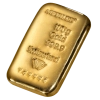

News on the gold price
SUBSCRIBE
Receive gold coins and bars prices every day
What is the spot price of gold?
The spot price of gold is the price at which gold is traded in real time on the international financial markets. It is expressed in US dollars per troy ounce: a unit of measurement specific to precious metals, equivalent to 31.1035 grams. For European investors, this price is then converted into euros according to the current EUR/USD exchange rate.
This price is determined twice a day via the LBMA Gold Price, administered by the IBA (ICE Benchmark Administration): a first announcement at 10:30 GMT, a second at 15:00 GMT. These two fixings bring together the world's leading banks: Goldman Sachs, JP Morgan, HSBC, Bank of China, Standard Chartered: as well as major precious metals trading houses. The equilibrium point between global supply and demand determines the price.
Unlike equities, there is no official closing price for gold: the metal is traded continuously on the Tokyo, London and New York stock exchanges, from Monday to Friday. The market closes every evening between 22:00 and 23:00 GMT, as well as on weekends and certain public holidays.
Spot and bullion prices: what's the difference?
It's a question all novice investors ask themselves. The spot price is not the price at which you buy or sell an ingot or coin.
The spot price is the worldwide reference for LBMA-certified ingots (purity 999.9 ‰). This is the wholesale price, the price for large-scale institutional transactions: usually starting at €50,000.
When you buy a 100g gold bar, bullion or coin such as the Napoleon or American Buffalo, the price incorporates a premium above the spot price. This premium covers manufacturing, storage and insurance costs, as well as the professional's margin. It varies according to the product: a few percent for a 1 kg ingot, up to 10-15% for common coins, and much more for rare coins with high numismatic value.
Furthermore, since July 30, 2004, there has been no official quotation for gold in France. Prices quoted by professionals are market prices, established daily on the basis of international rates and local supply and demand.
Why does the price of gold change?
The price of gold is never static. It constantly reacts to a range of economic, monetary and geopolitical factors:
Global supply and demand:
Global mine production, new deposit discoveries and mine closures influence supply. Demand comes from central banks, individual investors (ingots, coins, ETFs), jewellers and industry (electronics, aerospace, dentistry).
Interest rates and inflation:
Gold is a non-yielding asset. When real interest rates fall or inflation soars, bond investments lose their appeal and gold becomes more competitive. This mechanism largely explains the metal's sharp rise since 2022.
The US dollar:
Quoted in USD, gold has an inverse relationship with the greenback: a weak dollar makes gold cheaper to buy for investors outside the dollar zone, which supports demand and drives up the price.
Geopolitics and crises:
Armed conflicts, trade tensions, political instability: in times of uncertainty, investors take massive refuge in gold, whose value does not depend on any state or central bank.
Central banks:
Their decisions to buy or sell gold reserves weigh heavily on the market. In 2025, for the first time since 1996, the value of the gold reserves of the world's central banks exceeded that of their US Treasury bills: a strong signal of growing mistrust of sovereign debt.
Speculation and ETFs:
The flows of large investment funds can amplify short-term movements, independently of fundamentals.
Understanding the gold price chart:
How to read the gold price chart?
A gold price chart is based on two axes: the horizontal axis (time, from short to long term) and the vertical axis (gold price, often per kilogram in euros). To read it properly, you need to adapt the scale to your analysis horizon: short-term to observe daily variations, long-term to identify a global trend. It's also essential to check the unit (ounce, kilo, euro) and to spot high and low points, which reveal market perceptions and volatility.
How do I analyze a gold price chart?
Analysis begins with the trend: bullish, bearish or neutral. We can then go into more detail using simple benchmarks: comparing the current level with that of several years ago, identifying supports (rebound zones) and resistances (ceilings), and observing volatility. These elements enable us to situate the current price (low, medium or high), without predicting the future.
Is it possible to predict a rise in the price of gold using a chart?
No. A chart is a tool for observation, not prediction. It helps to understand trends, market reactions and cycles. However, the price of gold also depends on major external factors such as inflation, interest rates or the geopolitical context. We can envisage probabilities, but never certainties.
How to use the gold chart for long-term investing?
When investing, the chart is used to optimize your strategy: buy during downturns, smooth your investments over time and maintain a long-term view. The aim is to avoid impulsive decisions and to integrate gold into a logic of diversification and wealth preservation.
How to buy physical gold
Investing in physical gold is accessible to all budgets, provided you respect a few basic principles:
Choose the right product for your purpose. For long-term wealth investment, LBMA-certified bars (from 1g to 1 kg) offer the lowest premium over the spot price. The 1 kilogram ingot is the international benchmark: certified, liquid and recognized on all world markets. For a fractional investment or a first approach, bullion bars (5g, 10g, 20g) and bullion coins: Napoléon 20 Francs, American Buffalo, Britannia, Krugerrand: are ideal. They also offer specific tax advantages on resale.
Always go through an accredited professional. A recognized specialist will guarantee the authenticity of the product, provide you with a certificate of authenticity, and advise you on the timing of your purchase based on the current market price. Avoid buying from private individuals or on non-specialized platforms: the risk of counterfeiting or excessive overpricing is real.
Anticipate storage. Physical gold needs to be kept in a safe place: a personal safe, a bank vault or a secure storage service offered by your professional. This cost must be factored into your overall profitability calculation.
How to sell gold at the best price?
Selling gold correctly means choosing the right time and the right person.
In terms of timing, keep an eye on the price every day, using the chart and table on this page. Upswings triggered by geopolitical tensions or a weak dollar are often the best time to sell part of your position.
In practical terms, you should choose a professional who is specialized, independent and transparent about his valuation criteria. He or she should offer you immediate payment - never deferred payment - inform you of the reference rate used, and help you with administrative and tax formalities. In the case of coins, a numismatic expert will also assess rarity and vintage, which can significantly exceed simple value by weight.
Tax-wise, the sale of physical gold in France offers a choice of two regimes:
- The flat-rate tax on precious metals: %%TMP%% applied directly to the sale price, without having to justify the purchase price.
- Capital gains tax: %%TPV%% on the actual capital gain, with a 5% allowance per year of ownership beyond the 2nd year: i.e. total exemption after 22 years of ownership.
FAQ : Frequently asked questions about the gold price
What time is the gold price set?
The gold price is officially fixed twice a day via the LBMA Gold Price: at 10:30 GMT (11:30 French time in winter, 12:30 in summer) and at 15:00 GMT (16:00 / 17:00 in France). Between these two fixings, the price evolves continuously on the markets. Our price table is updated in real time.
Why does the price of gold rise in times of crisis?
Gold is a tangible asset, limited in quantity and independent of any government or central bank. In times of economic or geopolitical uncertainty, investors seek to protect their wealth: they turn away from risky assets (stocks, bonds) and buy gold, which mechanically drives up demand and the price.
What's the difference between the price of gold and the price of bullion?
The gold price is the world reference price for pure gold (999.9 ‰) on wholesale markets. The price of an ingot or coin is always higher than the spot price: it incorporates a premium that covers manufacturing and packaging costs and the seller's margin. The smaller the product, the higher the premium.
Can the price of gold go down to zero?
No. Gold is a rare metal with well-established industrial, jewellery and monetary uses. Unlike a paper currency or a company, it cannot go bankrupt or be devalued by political decision. Over 50 years, its long-term value has risen steadily.


